
CONFLICT by Peter Deckers (Sept 2024)
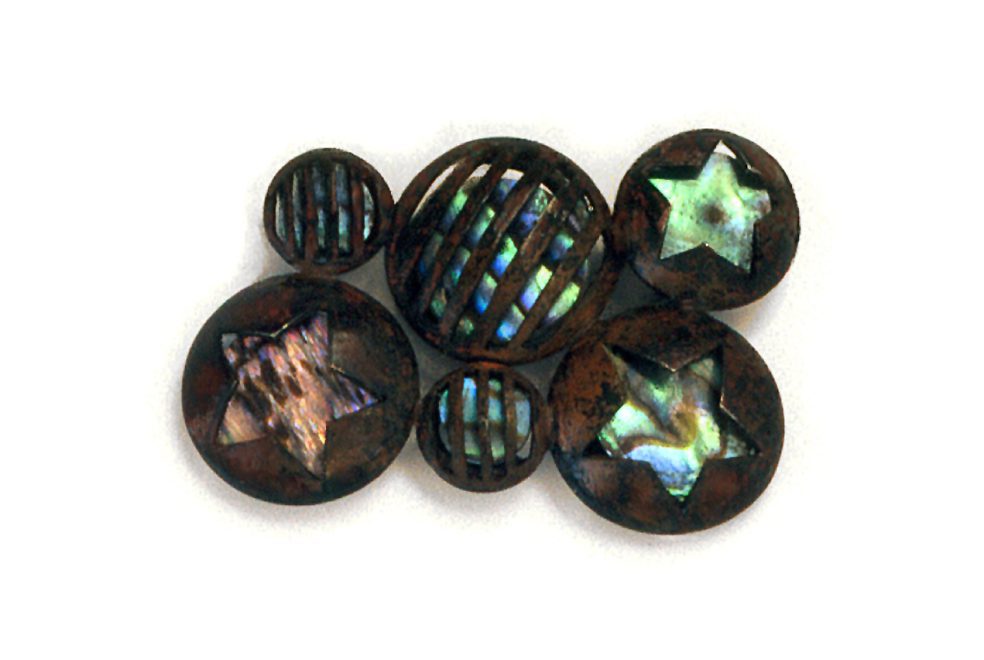
Stars and Stripes, 1999, brooch, pau shell, Nickel silver

Odd One Out, 2012, brooch, costume jewellery, gold, nickel silver, sterlng silver, pau shell

Eye to Eye, hair pin, 2002, silver, coins, bullet case
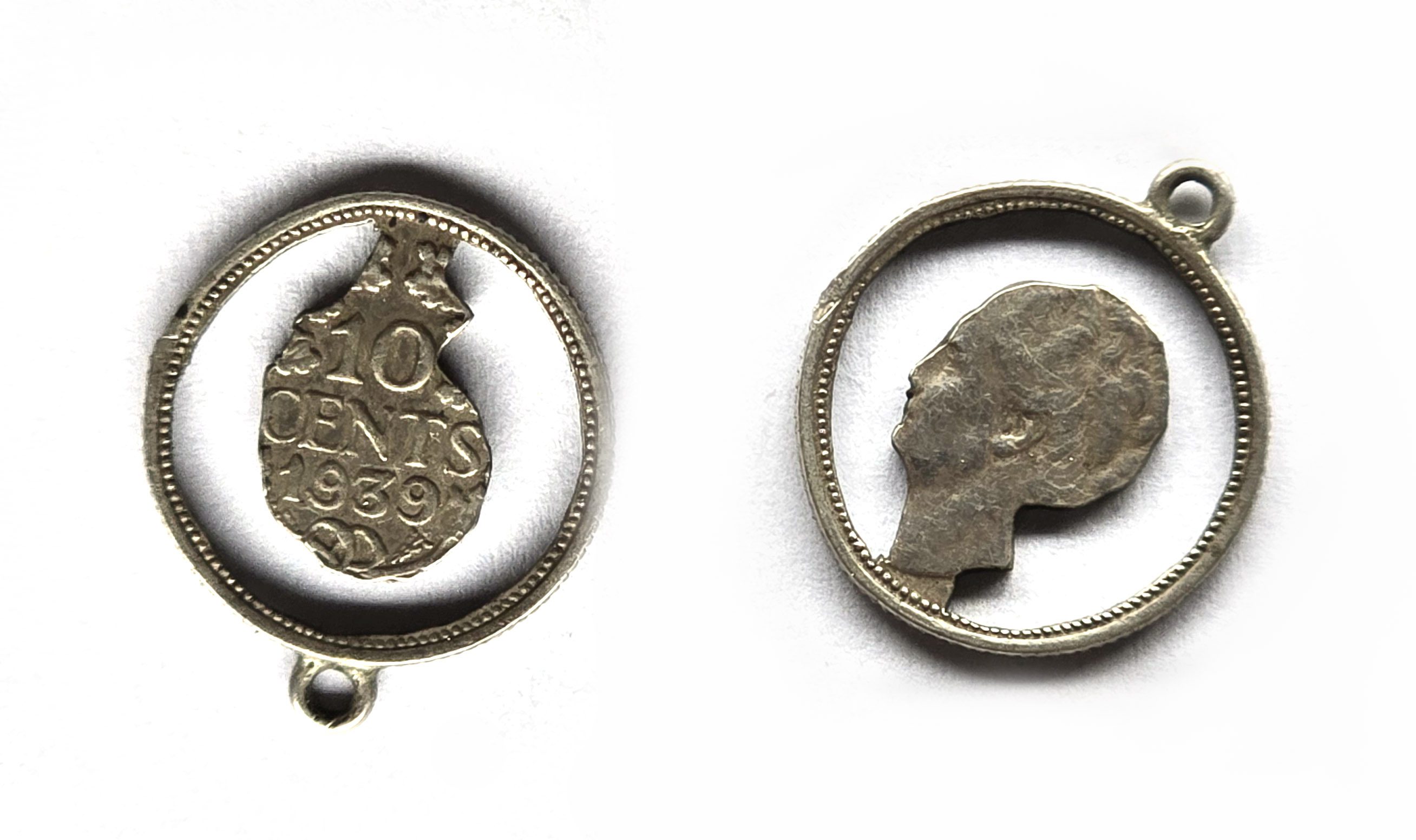
My mother’s pierced 10-cents piece

Baslan School Massacre, 2004, brooch, sterling silver, print, glass

In CONFLICT, I explore how fascism, corruption, and survival instincts become entangled with ignorance, corrosive politics, and violence — forming tightening loops that lead to destructive behaviours and dire consequences.
Across my life, I have witnessed relentless warmongering, with leaders, interest groups, and nations engaging in conflict and threats to assert dominance, secure ideologies, or control resources. Dominant powers impose their policies and rhetoric, while authoritarian figures stifle freedom and crush opposition, using fear and misinformation to manipulate populations. These are fear loops, propaganda loops, and control loops — systems that narrow perception until brutality feels inevitable. They silence dissent, erode trust, and undermine democracy, freedom, progress, and cooperation.
Such regimes rely on fear, repetition, and violence to maintain power at any cost, leaving societies fragmented and impoverished. In these environments, freedom of speech disappears, and the arbitrary judgment of who deserves to live becomes the most troubling reality. Journalists risk their lives to expose truth, defend human rights, and uphold freedom of speech — acting as counter‑loops that widen what can be seen and known, striving to sustain the possibility of a just society.
My first conscious encounter with injustice came at the age of nine, when I read an article with photographs of the 1959 Tibetan massacre carried out by the Chinese. It unsettled me profoundly. Yet even before this, injustice had already marked my family’s story. In 1944, during the Second World War, my mother — then a teenager in occupied Holland — worked for a local jeweller. Her task was simple yet subversive: cutting the Dutch queen’s head out of devalued silver 10‑cent coins. These fragments were transformed into bracelets, exchanged for food, and worn as tokens of protest and hope. In the darkest moments of repression and hunger, jewellery became both sustenance and symbol: a fragile act of resistance, a way to carry dignity and defiance against tyranny. Even then, resistance loops were forming — small gestures widening what oppression tried to narrow.
How does my jewellery fit into this flippant context? It does not fit well at all. Culture cannot flourish under oppressive conditions. I recognise that my critical position is one of privilege, allowing me the freedom to discuss these conflictual issues openly. Yet under repression, things of beauty take on heightened meaning. They become a joy, a memory of what was, or a fragile glimpse of what might be.
Authoritarian regimes often construct a false sense of normality. Even Nazi magazines, designed to mask brutality, were filled with images of smiling children, flowers, majestic mountains, and happy mothers — and even glamorous, smiling officers in immaculate uniforms. All of it was carefully staged to overwrite reality, to present harmony where violence and terror defined daily life. These were illusion loops, crafted to reassure, distract, and conceal.
But those living under oppression know that this manufactured normality is broken. Their gestures of beauty, protest, or care arise from that awareness. They are not decorative; they are counter‑loops — small acts that keep dignity alive, that widen what the regime tries to narrow, that insist on a reality beyond the one imposed.
I was reminded of this paradox during the Bosnian war, when I saw a BBC report showing three women walking through devastation in mini‑skirts, tight clothing, jewellery, and high heels, as if they were going out. When the reporter stopped them, pointing out that there was a war, they replied: “We know. We are fighting with what we are good at… with beauty, to let the fighters know what the other side of life can be, what they miss.” That moment struck me profoundly. It showed that beauty, even in its most fragile or everyday forms, can become a counter‑loop — a reminder of dignity, a vision of life beyond violence, a widening of the world when everything else is narrowing.
Decades earlier, during the Vietnam War, the youth movement rose in protest. Privileged teenagers, empowered by freedom of speech, marched, sang, and challenged authority — insisting that another world was possible. Their voices, though often dismissed, became a chorus against war and injustice, showing how collective action can resist violence in its own way. As a teenager myself, I was inspired by Bob Dylan’s protest songs, filled with social and political commentary. Through his music, I learned the power of art as a medium for engaging with urgent issues. This ignited my commitment to the anti‑war and civil rights movements, as well as my drive to advocate for justice and change. Dylan’s poetic bridges showed me how art could contribute meaningfully and critically to the pursuit of justice, freedom, and transformation. It became my mission to stand against fascism, surveillance, and oppression — to resist brutal indoctrination, the erosion of freedom of speech, and the corrosion of democracy. My work seeks to expose these forces, to confront their violence, and to preserve memory through poetic acts of beauty and protest. They help stabilise what conflict tries to unravel — memory, justice, and the ongoing work of repair.
The projects related to CONFLICT, such as the ‘Shut-Up Series,’ ‘Acoustic Tile,’ and the ‘Great Known to Man Series,’ Mourning Jewellery of the Chornobyl Collection, and ‘Most Wanted‘ serve as tokens of protest, memento mori, awards for bravery, symbols of courage, and poetic keepsakes preserving memory. They also stand as pledges of “never again,” raising bigger questions about our moral compass and judgment of what is good and bad.
In parallel, the Pleasure Beast projects confront another dimension of violence: the spectacle of killing staged as entertainment. Sparked by a disturbing advertisement I encountered around 2010 from South Africa, offering a safari hunt where giraffes could be killed for US$9,000, these works expose the commodification of life and the immorality of turning suffering into spectacle. Pleasure Beast reveals a dominance loop — the arrogance of deciding who may live and who must die. I see all living creatures as important, and I cannot stand the ignorance of violence disguised as superiority. Pleasure Beast insists that animals are beings who deserve to exist beyond our games of dominance, and it calls out the moral failure of framing death as leisure.

‘Vice & Virtue copyrighted copy’, 2005, brooch series: sterling silver

Serbian Dream, brooch, 1992. silver, old costume jewellery, gold leaf

After the War, brooch, 1989, silver, nickel silver

Copy That, brooch, 2004, silver, mirrors, print, crystal glass

Shut Up series, two keys, pendants, fine gold, iron steel, string

Hand to Eye, two brooches in box pendant, sterling silver, print, mahogany box, string

Hand to Eye, (nail from the cross) pendant, sterling silver, string

9/11 Quantum, 2001 (from The Reproduction Guild project) 2 times 110 brooches, steel, safety pins

9/11 Quantum, 2001 (from The Reproduction Guild project), brooch, steel, safety pin

“The most disadvantageous peace is better than the most just war“.
“War is sweet to those who haven’t tasted it“.
The Shut-up series (the Great to Known to Man series), 2003
Throughout my life, I have been unsettled by the stories of tyrants and politicians who suppress basic liberties — freedom of speech, freedom of choice — and who take lives without reason. My parents spoke of how, in an oppressed society, survival instincts take over, shaping what can be trusted and what cannot. Under such regimes, silence becomes a tactic, fear circulates quickly, and distrust becomes a way of navigating daily life.
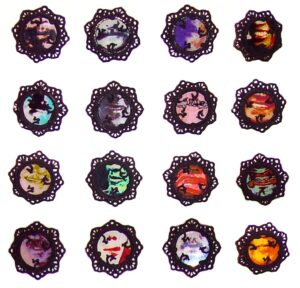
I gathered images of the dictators who had troubled me over the years, removed their smiles, and placed those smiles into brooches. These brooches were then locked away in a cupboard that can only be opened with one of two keys: one made of pure gold, the other of rusty steel. The gold key can be used only once — its softness ensures it destroys itself in the act of opening. The steel key, however, can be used again and again. This small mechanism became a reminder of those who remain true to their essence, who refuse to bend toward corruption, and who continue to resist. It honours the people who stood against these regimes and fought for their freedoms and human rights.
The work also reflects on how influence circulates — how information, images, and media can be used to steer thought and behaviour, often without our awareness. Influence rarely arrives as a single event; it loops, repeats, and settles into the environment until it feels natural. Systems built on distortion create cultures that mirror their origins, tightening or loosening the space in which people can speak, act, or even imagine alternatives.
The series raises questions that remain unresolved: Do we choose to be influenced, or does influence choose us? Are we aware when it happens? Can we resist it? And is it ever possible to remain untouched by the systems that surround us?

Acoustic Tile, 2004
This installation examines the societal impact of developmental intrusions, particularly in the context of the September 11 attacks. Decisions made during this process affected everyone, leaving no choice but to accept all consequences.
The event left us with a new normal. Political control, surveillance, mistrust, digital propaganda, digital disinformation, conspiracies, and restrictions on freight and travel all became part of this new reality. The aftermath of 9/11 saw a surge in a “SHUT UP” mentality, where dissenting voices were often silenced in the name of national security1. This environment fostered a culture of fear and compliance, further solidifying the misuse of power.
The installation contains a sound piece behind the plaster acoustic tile that represents annoyance and disturbance, featuring the repeated sound of a fly moving from left to right and Bush saying, “I want revenge, ahum, ahum.” On the shelf are two toys: one is a petrol tank and the other a shooting tank. Both carry jewellery that acts as symbols of ignorance and revenge. These pieces of jewellery serve as poignant reminders of the consequences of unchecked power, excuses for control and retaliation. They stand as solemn vows of ‘never again,’ underscoring the necessity of learning from history to avert future tragedies. The religious wars from the Crusades are still being fought as excuses for gaining control of economic and strategic resources, like oil and strategic power. Through this installation, we are reminded of the fragility of peace and the importance of vigilance and empathy in our collective journey towards a more just and humane world.
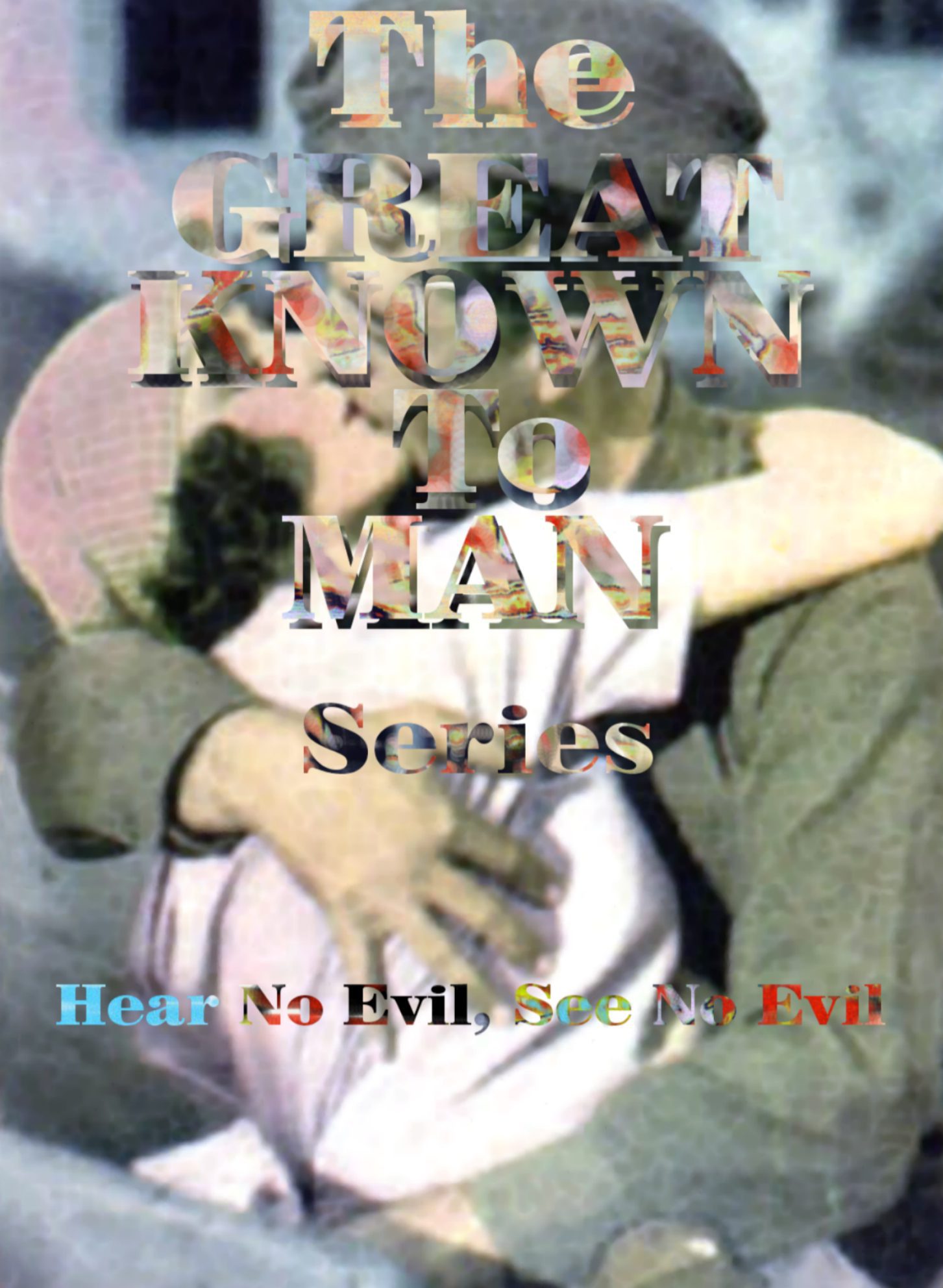
Hear no Evil, See no Evil


Bush & Saddam, 2003, two brooches: bronze, gold, print, acrylic


Solitaire Ring for the Ruthless Scientist, 2000 (left) and World Leaders’ Trust,1989 (right)
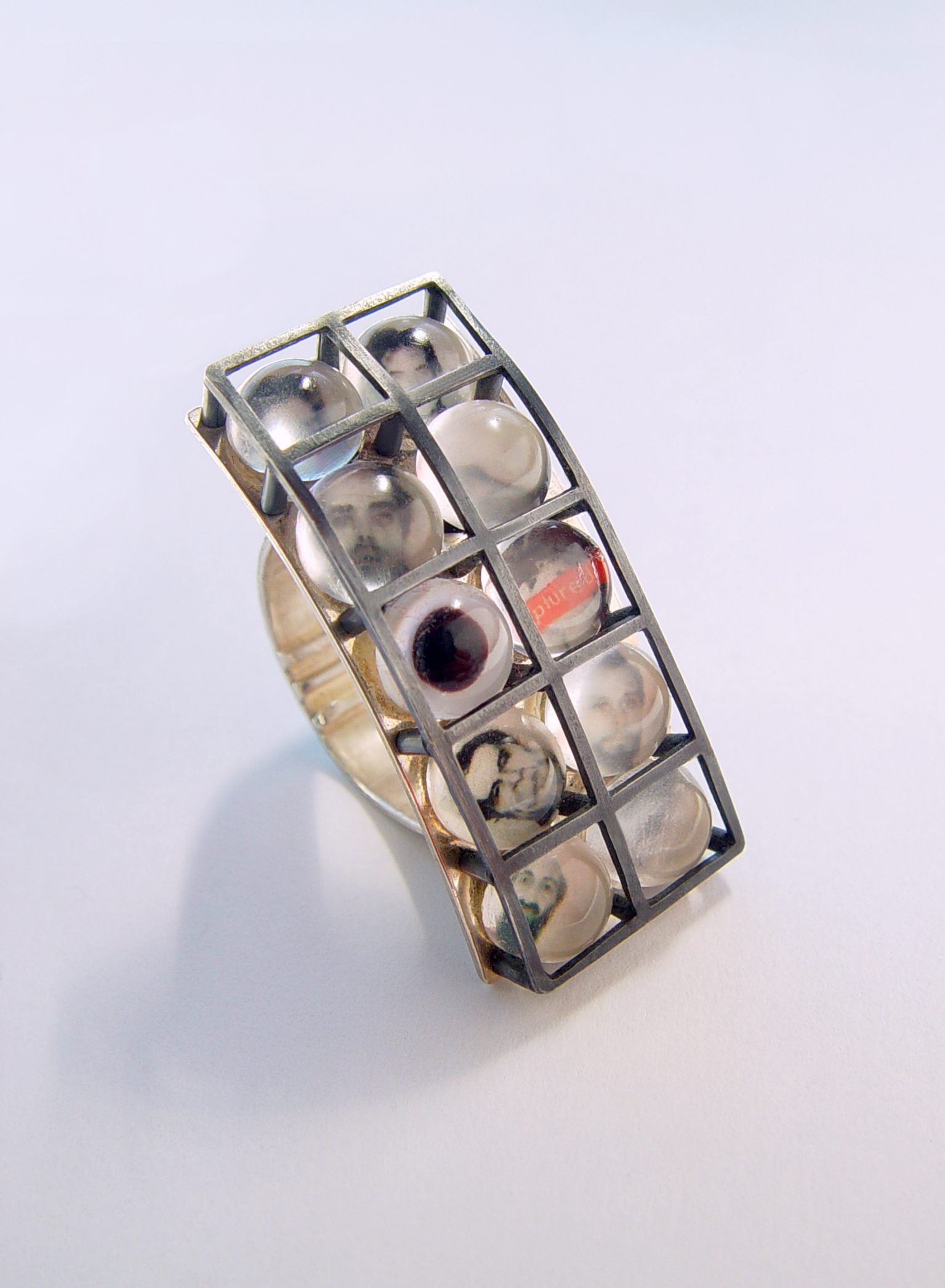
Most-Wanted
The “Most Wanted” ring redefines what a story can be. Jewellery is often a vessel for love, lineage, and remembrance — a mother’s ring, a wedding band, a keepsake that compresses a lifetime into something small enough to wear. But some stories are unbearable. Sudden, violent, and irrevocable, they must be compressed into objects simply to be carried at all. A ring becomes a container for what cannot be spoken.
This work turns that tradition inside out. Instead of gemstones, the ring holds nine images from the FBI’s Most Wanted list of the year 2000, each sealed behind crystal glass. At its centre sits a glass eye from a collapsed stuffed extinct bird — a witness from a vanished world. These elements form a narrative of rupture: where jewellery usually symbolises devotion and continuity, these “gemstones” represent corruption, violence, and the sudden rewriting of lives.
Criminals can be captured or forgotten, but the people they harm — families, friends, communities — carry the consequences forever. A single act can create a story that cannot be undone. The ring becomes a monument to that asymmetry: the perpetrator moves on; the loved one is gone.
The title Most Wanted carries its own polarity. In everyday life, it names what we cherish — the person we cannot live without. In the context of the FBI list, it marks those who destroy, fracture, and erase. The same phrase holds two incompatible worlds: the loved one who is “most wanted,” and the person who takes that loved one away.
The juxtaposition of the most‑wanted images with the glass eye of an extinct bird exposes how value shifts once a story is revealed. A gemstone can be precious or empty; a scrap of glass can become a relic. The ring becomes a compressed archive — a reminder that stories, whether cherished or devastating, survive because we find a way to hold them.

Pointers
Journalists are the first line of defence in the global battle for justice, freedom of speech, and democracy. They inform our connection with the world, feeding both knowledge and creative inspiration.
Journalists risk their lives and often work under extreme conditions to bring us crucial information about corrupt regimes, human rights abuses, and other societal issues that need our attention. In 2021 alone, 293 journalists were imprisoned worldwide, the highest number since the Committee to Protect Journalists began keeping records, underscoring the importance of protecting journalists so they can continue their vital work.
Their fearless reporting holds those in power accountable and exposes the truth, igniting change and fostering transparency. As global citizens, we rely on them to inform us and push humanity towards progress and harmony.
Other lines of defence are scientists who concentrate on reducing human suffering and religious and political leaders who can bring people together compassionately.
I seek in my work to highlight some of these struggles, using creativity to shed light on issues of conflict, injustice, or confusion, inspiring questions, debate, and action.
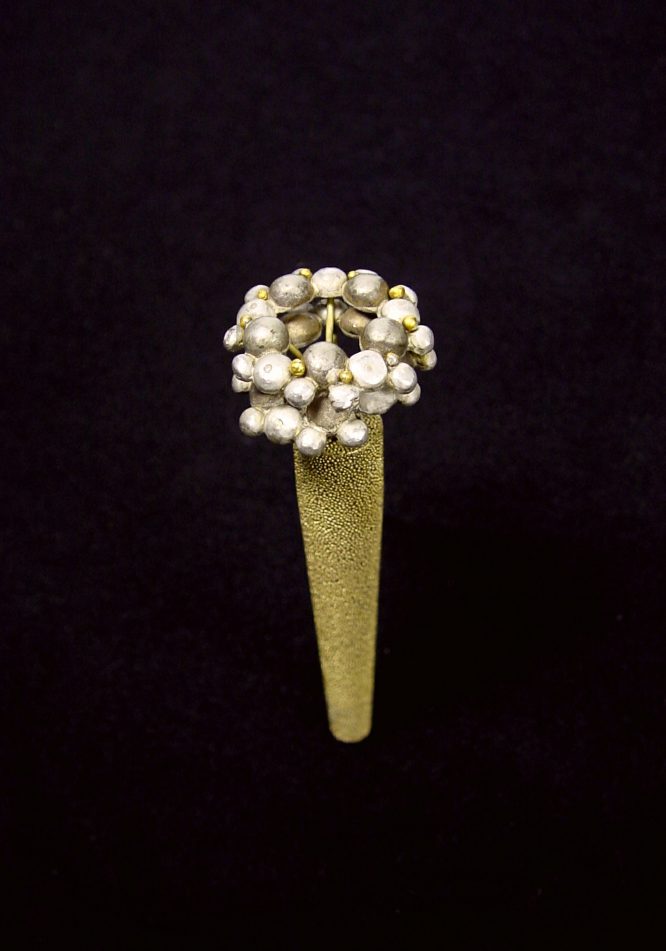
Award for the Hiroshima Bomber, brooch 1, brooch, 1989, goldplated bronze glass filter, st silver and nickel silver
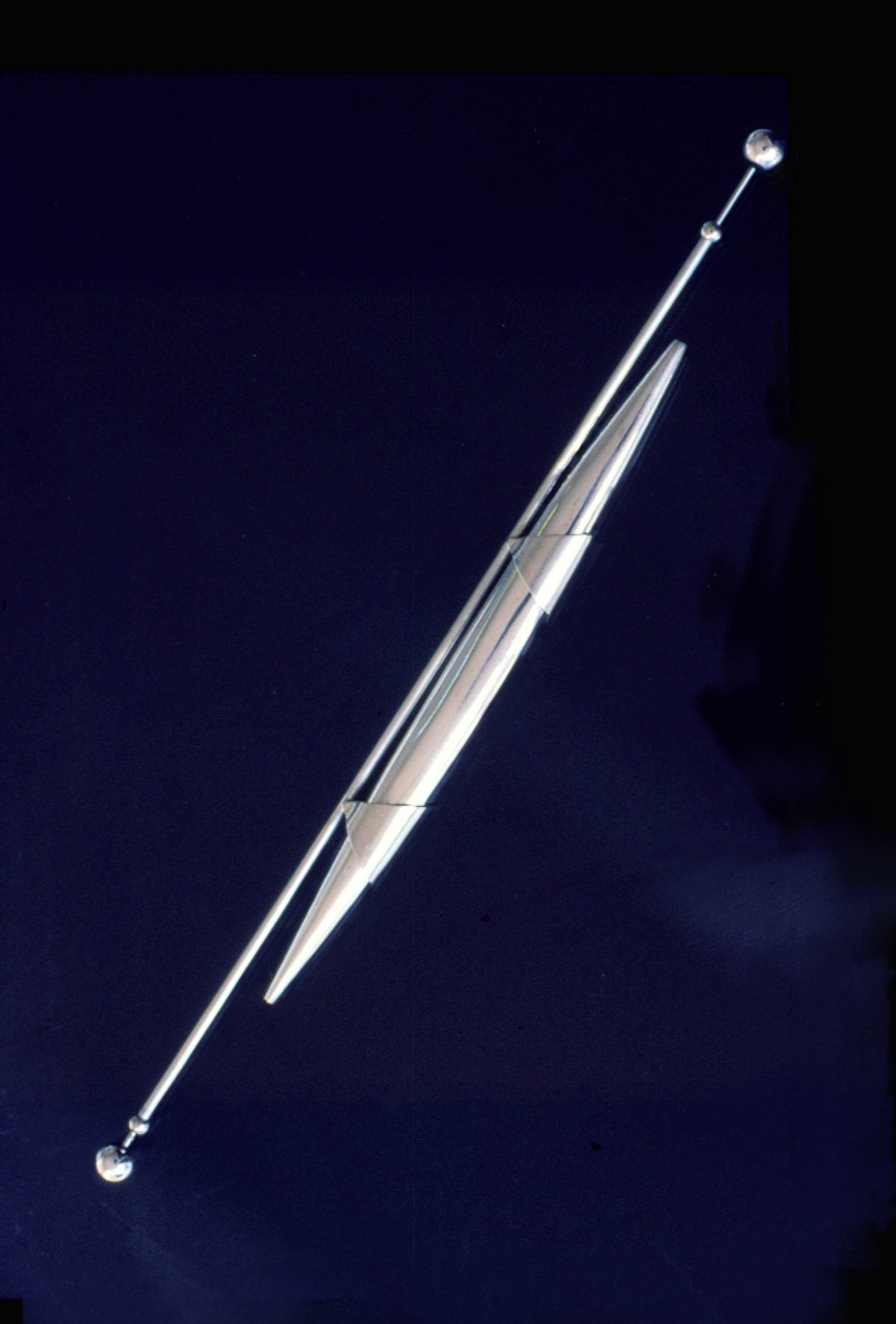
(two) World Leaders’ Trust, lapel pin, 1989, sterling silver

Peacemakers, in Moving Targets, pendant, 2009,
Empty bullet cases, sterling silver, bronze, laminates, kumihimo braid
Peace Makers (from the series Moving Targets), 2009
Peace Makers necklace confronts the paradox of peace achieved through violence.
I assembled a cluster of empty bullet casings—once vessels of destruction—and reimagined them as carriers of colour, embellishment, and symbolic offering. These hollow forms, like the vacant claw setting at the top—typically used to cradle a gemstone—draw attention to what is missing: the celebration, the resolution, the precious core. Their emptiness becomes a quiet indictment, evoking the absence of peace, the cost of conflict, and the deferred promise of healing.
The work reflects my concern with the fragility of democracy, the manipulation of innocence through propaganda, and our enduring failure to learn from past wars. Drawing on my ongoing inquiry into value and its corruption, Peace Makers reconfigures instruments of harm as objects of reflection and potential transformation.
The inclusion of kumihimo braid, historically used in Japanese armour, evokes both protection and ritual, anchoring the work in a lineage of resilience and ceremonial care.
Exhibited in Talisman, Christchurch Art Gallery Te Puna o Waiwhetū, 2009. Curated by Jennifer Hay.
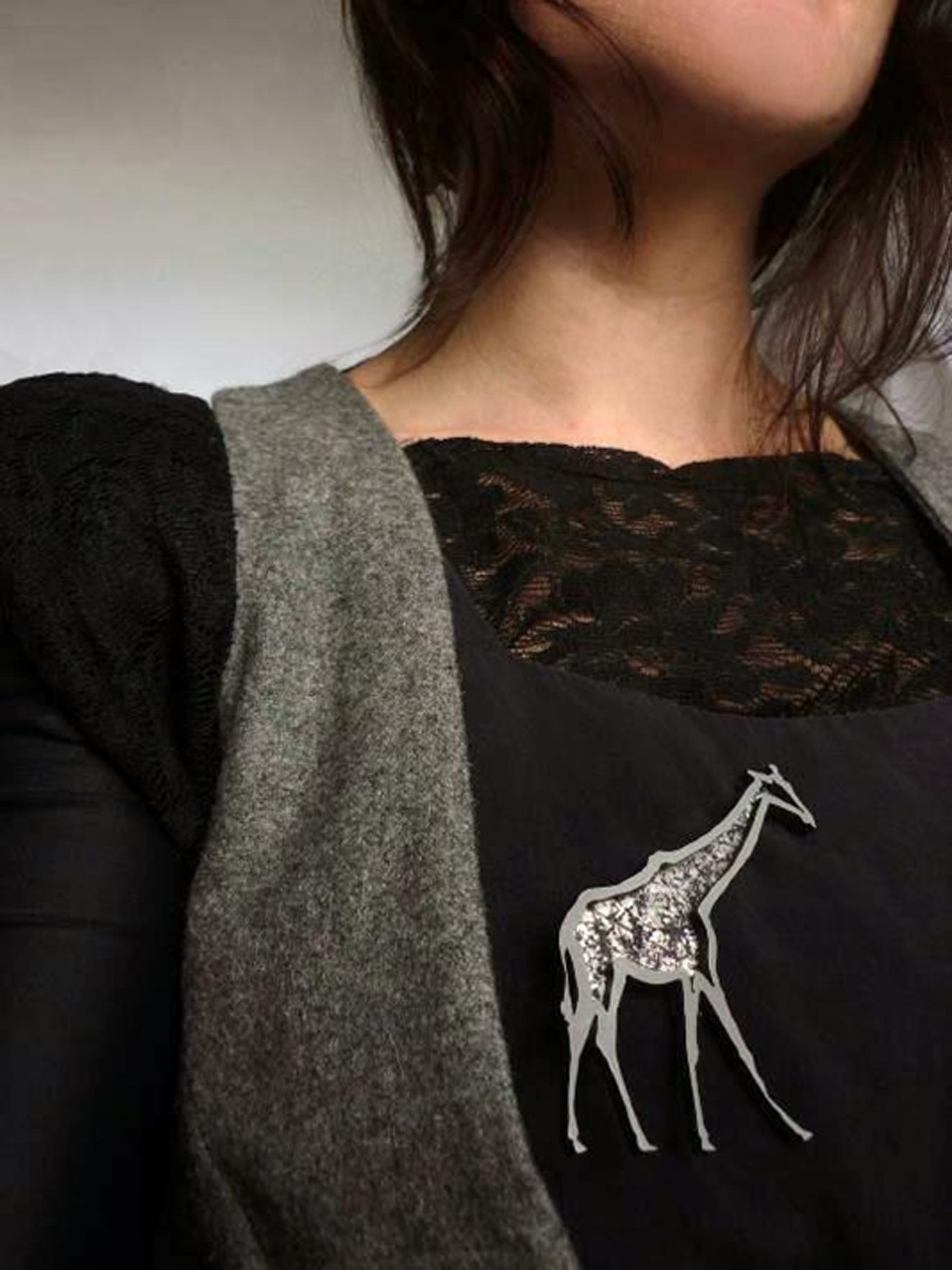
Pleasure Beast, in Moving Targets, brooch, 2012, Aluminium, vinyl, silver
Pleasure Beast in Moving Targets (from the series Moving Targets), 2009 – 2013
legitimate killing for pleasure and entertainment
This project confronts the spectacle of killing staged as entertainment.
The project began after I encountered an advertisement around 2010 from South Africa promoting a safari hunt where giraffes could be killed for approximately US$9,000. The idea that such an animal could be priced, targeted, and killed as leisure was shocking — a commodification of life that echoes other historical moments when human beings themselves were treated as expendable. That image of sanctioned killing has stayed with me, emblematic of how human culture continues to frame life — animal or otherwise — as disposable, and killing as a form of sport rather than a violation of dignity.
While survival or protection may once have justified acts of violence, the deliberate orchestration of death as entertainment exposes a deeper moral failure. It reveals a loop of dominance in which suffering becomes spectacle, and life becomes something to be purchased, displayed, or extinguished for pleasure.
Within the broader Moving Targets series, Pleasure Beast insists that animals are living beings who deserve to exist beyond our games of power. It calls out the immorality of turning their vulnerability into entertainment. These works are not only critiques but reminders: art can expose the cruelties we normalise, and it can ask us to reimagine our relationship to life, justice, and memory.
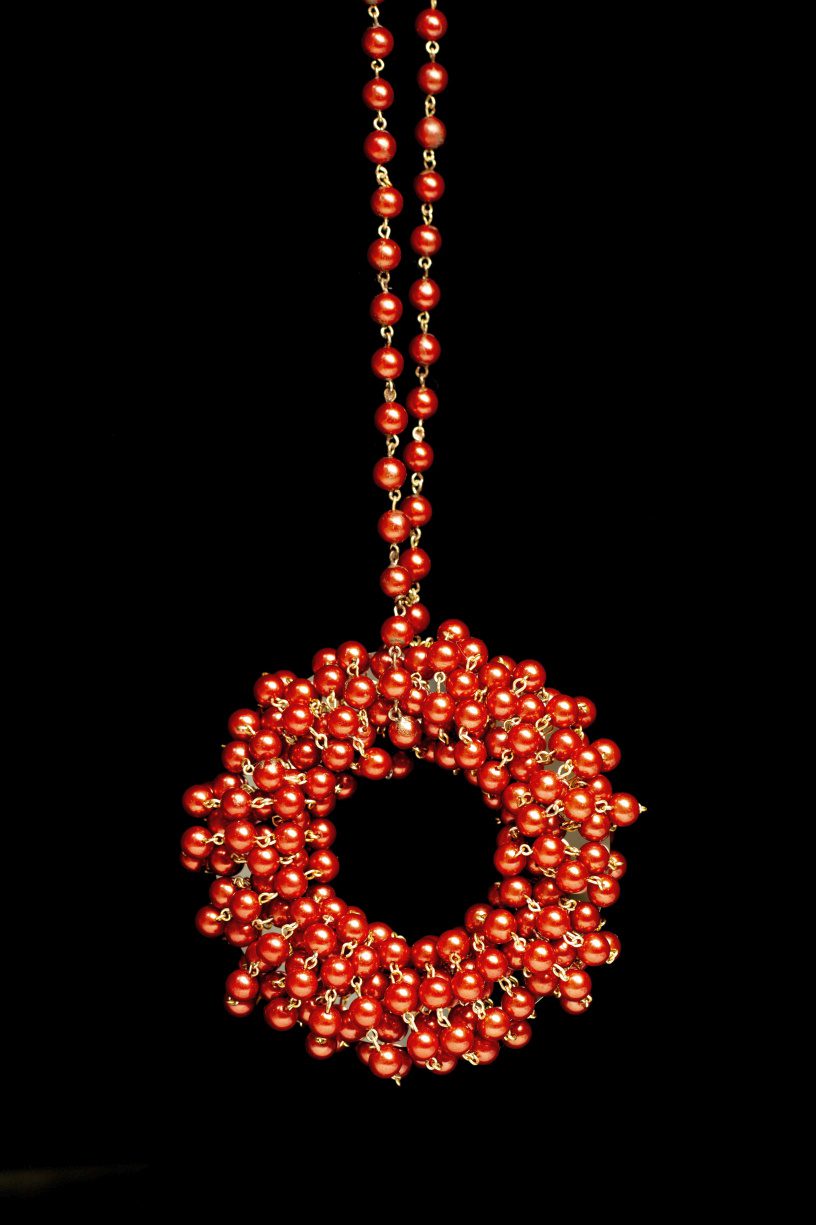
LOOPING LOAD (Cosmic Fusion), pendant, 2024, (new) antique costume jewellery chain, hard drive, resin (100x30x560mm)
CONFLICT: Systems Under Strain
When societies begin to tighten, the shift is rarely dramatic. It starts in the small distortions — the softened truths, the narrowing of what can be said, the quiet sense that the present no longer reflects the people living inside it.
Control gathers slowly, almost politely, until the world feels thinner than it should.
And yet, even in the most constricted environments, something human keeps slipping through: gestures of care, flashes of defiance, moments that refuse to fit the official story.
CONFLICT traces these tightening loops — the pressures and counter‑pressures, the illusions that hold systems together, and the fractures that appear when perception can no longer keep pace with reality.
It follows the point where stabilising loops begin to destabilise, where narratives harden, and where the human signals that don’t fit the system become impossible to ignore.
It asks what remains possible when a system tightens —
and what still finds a way through