
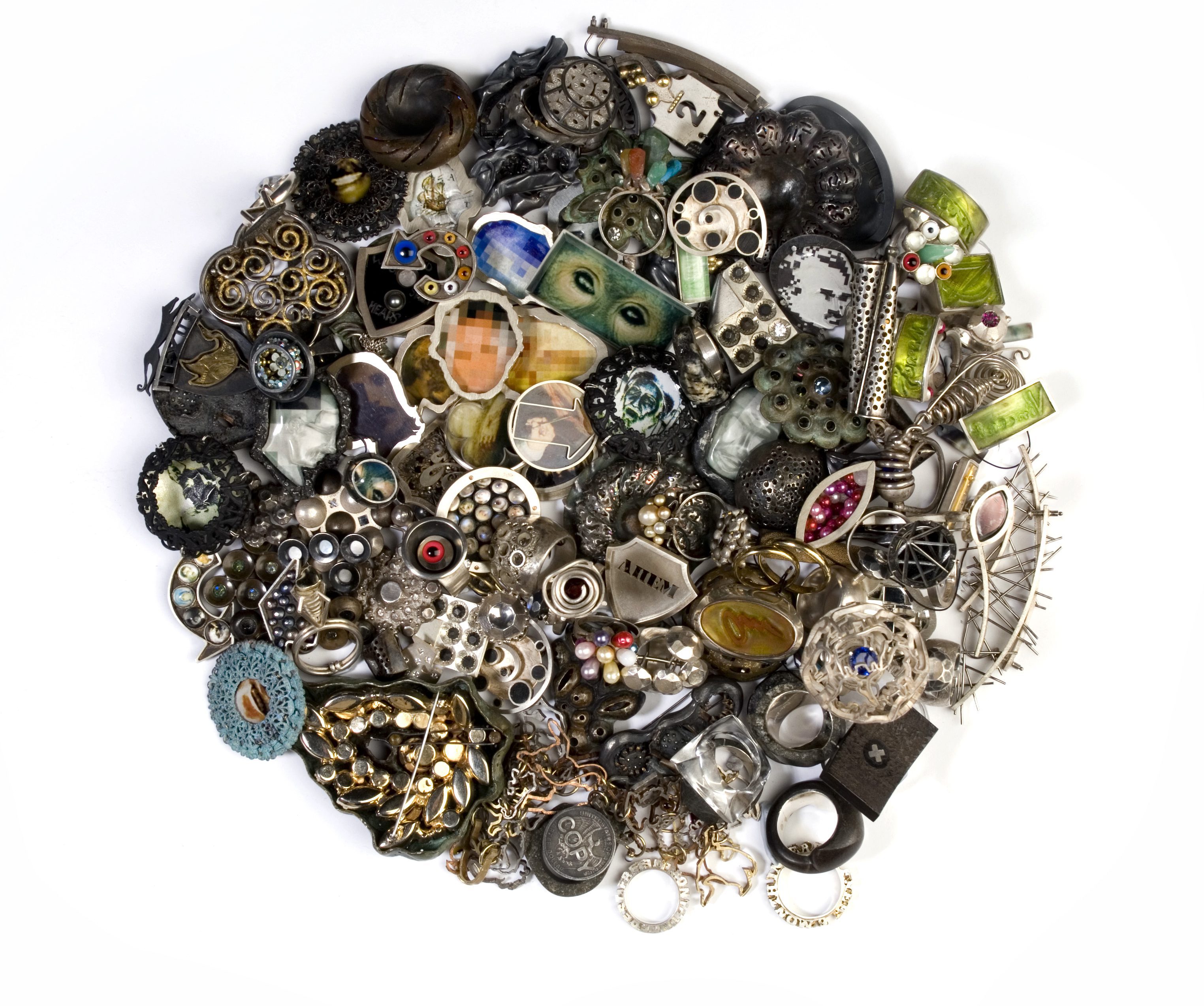
Who is Peter Deckers? What is his Jewellery about? What is he trying to do?
Peter Deckers is a non-commercial, conceptually driven artist working with the medium of jewellery. His life so far lasted for more than half a century, during which he has circled the globe seeking answers to questions we all ask ourselves about origin and identity, Peter asks more searchingly, however, than most, His works are material explorations of thought and feeling. They are often intensely personal, yet at the same time political, abstract and intellectual.
“I DON’T THINK I’M AN ARTIST,” HE SAYS. “I’M A MAKER OF MATERIAL IDEAS”.

The story of Peter Deckers, written by Dr Stevan Eldred-Grigg, 2006
Peter Deckers’ work has been described as full of playful signs, some deadly serious. Like all jewellery, his pieces can be seen simply as objects with shapes, masses, and surfaces. Traditionally, jewellery creates a sense of control, continuity, and presence, asserting culture over nature. However, few makers or wearers see these small adornments as symbols or signalling systems of ideas. Peter is well aware of this and elaborates ideas through his work.
Jewellery traditionally uses conventional signs: a diamond tiara symbolises wealth and rank, a jade tiki connotes mana and ancestry, and a bright plastic brooch suggests street culture. Peter Deckers, however, employs signs uniquely. His designs function more as a language than abstract art or decorative jewellery. To fully comprehend his works, one must master or at least be familiar with this distinctive language.
Consequently, each work is unique. Peter rarely repeats a design. “The subjects I dabble in,” he says, “are drawn from origins, perception, environment, & conflict.”
These four themes underpin his collection, often overlapping and significantly shaping the way Peter works, experiences, and tries to make sense of the world. “Does it sound like my work is all over the place?” he asks ironically, “doing so many things at once and on my own?”
A work by Deckers may or may not be considered jewellery. He uses found objects, print, nickel silver, and traditional precious stones and metals. He works with an awareness that, in the 1970s and 1980s, avant-garde jewellers shifted from precious to non-precious materials. There was widespread excitement but also conceit and self-congratulation about this shift. Peter believes that the more sophisticated people become, the less they want jewellery for show—they become more interested in the mind behind an object than in shiny surfaces. Rusty iron can be as interesting as gold.
Now, fashion has drawn most jewellers back to precious materials. Peter thinks these shifts are celebrated for the wrong reasons, and innovative ideas are often set aside by jewellers who follow the latest arbiters of taste to make a living. ‘Idea-makers need showcases and platforms,’ he observes, ‘not attitudes set by financial, commercial, and political interest groups, commodified by fashion, gallery shops, or even public-funded museum floors. The fine arts industry distances itself from solving such a complex debate, making the craft hybrid worker lonely.’
Peter certainly fits the adjective ‘hybrid.’ He responds intensely to technology, with computer technology shaping some of his jewellery projects. Sound is also present in his works, with spoken words and voices creating an ambient audible environment around installations. He hopes that by being a hybrid, he can highlight the many hand workers crossing the ‘elusive and evasive’ boundaries between craft-arts and fine-arts. ‘Words with a whiff of hope and despair!’ he comments.
Peter sees his works as a language, mirrors reflecting the world, and scales representing society’s values. They balance the ways our world may or may not determine worth. Yet, there’s more to uncover.
Peter seeks the void behind things that, at first sight, appear spoken, mirrored, or weighed, especially those voids in human politics, whether ethical or corrupt. He aims through his work to synthesise our existence in cultural, physical, and metaphysical realms. He appreciates complexity, though he doesn’t deliberately pursue it—it naturally arises because of the intricate world we live in.
Peter enjoys the workbook stage of a project, using old thoughts as a springboard for new ideas. He loves doodling and embraces ‘humble trial-and-error’ allowing materials, forms, colours, and textures to shape his work. Though he uses mock-ups, he often considers himself a ‘chance worker,’ stumbling upon shapes, looks, or finishes by accident, which he believes are informed by extensive research and thought.
Jewellery, his first love, captivates him with its making, tooling, knowledge, unique discourse, and historical connection. He cherishes the surprising accidents and unlimited possibilities of the craft. Most importantly, he loves how the best jewellery signals freedom, choice, and individuality when worn.
How did Peter end up making such unique jewellery? What are his geographical and emotional roots?
THE NETHERLANDS AND THE EARTH
Peter was born in Rotterdam, in 1953, amidst an oily harbour filled with cargo ships and bomb craters. These craters, remnants of the Luftwaffe bombings during WWII, were playgrounds for children like Peter. The sand, contaminated by the city’s history, had a distinctive stench. Rotterdam, a working-class city, was rebuilding and trading its way up, contrasting with bourgeois Amsterdam.
Pre-war Modernism shaped the city, epitomised by the Van Nelle factory, an icon of streamlined Europe. Post-war Rotterdam embraced ‘Instant Modernism’—colourless, stark, and routine. The city, however, was smoke-choked and filthy. Peter critiques Modernism for prioritising aesthetics over how people live in reality.
The Deckers family, middle-class, lived in a pre-war modernist apartment block with an imposing, bleak hallway. Peter’s father, a retailer of interior goods, aspired to be an architect, while his mother meticulously cleaned their home and did all the cooking and caring.
Peter’s early environment, marked by industrial starkness and post-war rebuilding, deeply influenced his perspective and work.
“Modernists don’t think about people,” Peter asserts. “They think about how a thing looks, and how they want people to live in it, not how people live in reality.”
Although Peter’s family was financially stable, they were not wealthy. Peter recalls the early years as times of penny-pinching. The family, Catholic but not fervent in religion or politics, lived conventionally in a nondescript apartment. “We always pretended, and I hated that—that’s probably why I explore perception in my work,” Peter reflects, noting how they often pretended to be wealthy.
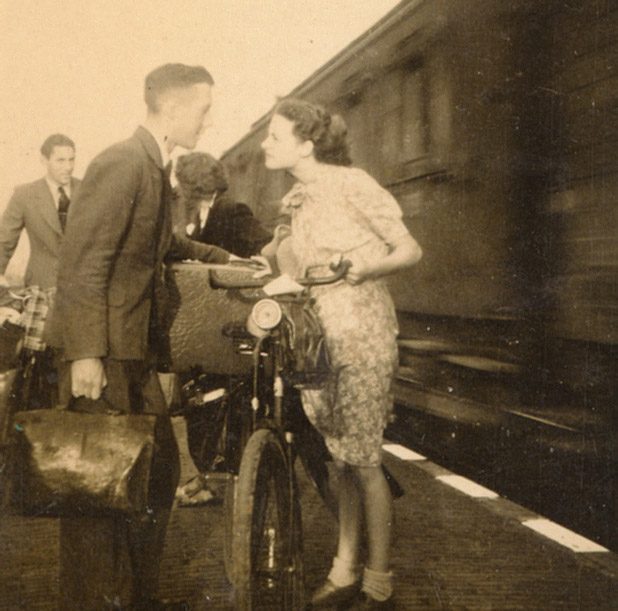 Peter’s mother, despite her social pretensions, was caring and protective, giving him much love. To the imaginative young Peter, she seemed like a typical mum, lacking an artistic eye. She constantly spoke about the war, hunger, and fear, aware of the sudden loss that could strike during seemingly ordinary days. The family, city, and country appeared haunted by war.
Peter vividly recalls the fear when the Berlin Wall went up, staying with his grandparents who spoke as if a Third World War was imminent. “I felt their fear; I felt the fear of everybody during those years,” he remembers.
His mother recounted working for a jeweller during the Hunger Winter, the last winter of the war, to help her family find food. Despite no training in jewellery, she was nimble enough to quickly learn simple tasks, like cutting Queen Wilhelmina’s head out of silver coins rendered worthless by the war.
No longer the coin of the realm, those little wheels of ore retained worth as both precious metal and symbols. Queen Wilhelmina represented resistance against the Nazis. Hearing from his mother about the jeweller reworking the royal head into bracelets and necklaces, Peter was intrigued by the transformation of something devalued into a new value: defiance and freedom. His mother even showed him a bracelet made from cut coins and explained how she was paid in kind for her work. This intrigued Peter further, highlighting how money loses value in wartime while other things gain significance.
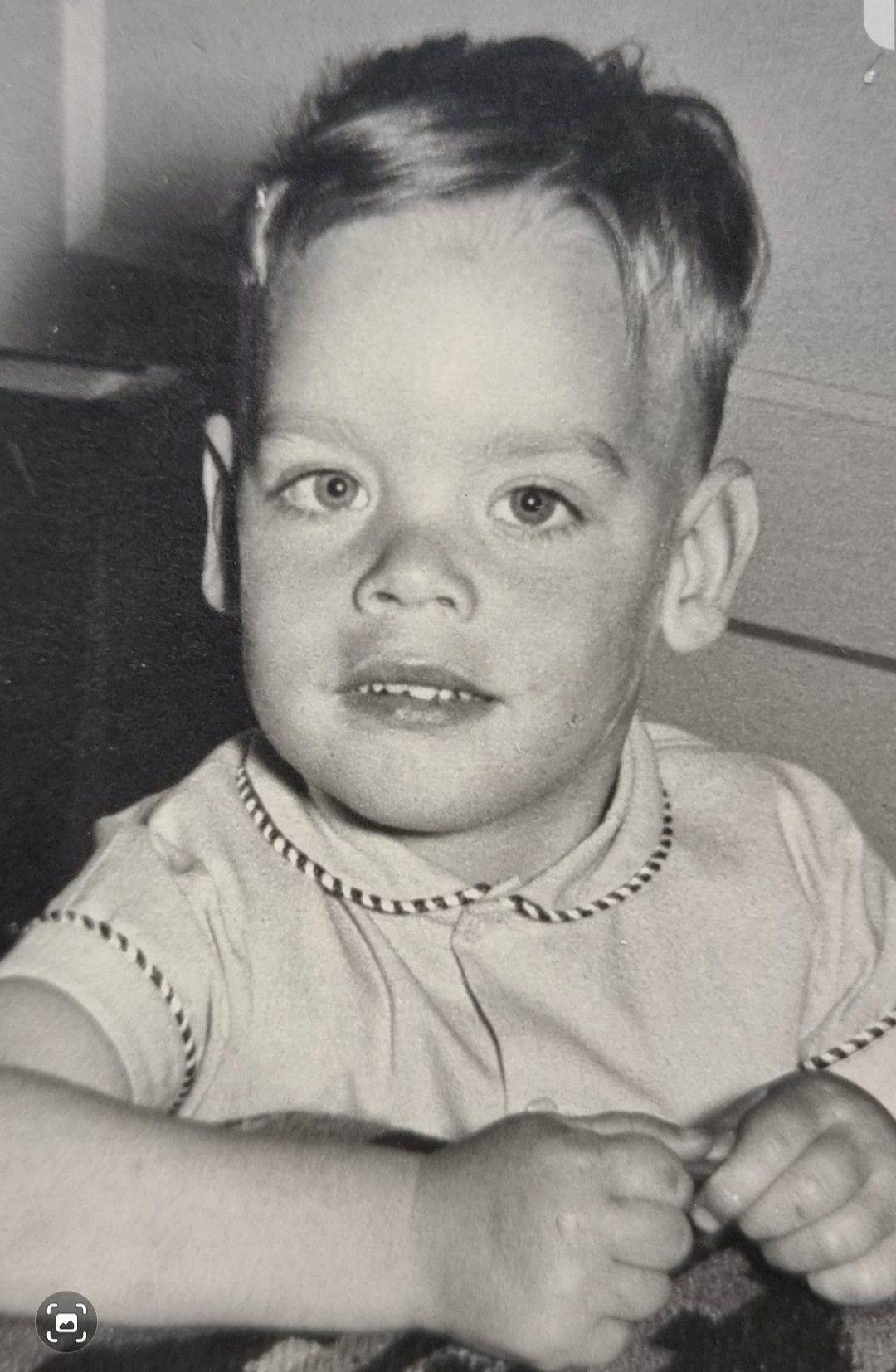 Peter’s curiosity as a child was piqued by an object sent to Rotterdam by a great aunt living in New Zealand—a Paua shell, glowing with lustrous and iridescent colours. In contrast, seashells in his country were grey. He often played with the paua shell that housed the shiny jewellery collection of his mother. This made Peter think that other parts of the world were more colourful than the Netherlands. “Everything is grey in Holland!” he laughs. As the post-war economy boomed, Rotterdam, along with Peter’s family, began to prosper. The city entered what could be called the ‘Sugar Age,’ with sweets, petrol, and money becoming more affordable. “Everything,” says Peter, “became accessible and prewrapped.” One year, when he was ten or eleven, Peter, his mother, brother, and sister returned from a summer holiday to find their father had completely redecorated the apartment in a modernist style. Surfaces gleamed, and chairs swivelled on circular bases. His mother was horrified not by the style but the cost. “The whole place was totally stylish,” says Peter. “I saw that total transformation and thought, wow fantastic!” From that day onwards, Peter has been excited by sweeping renewal and new adventures. He believes this excitement stems not only from his father’s surprise renovation but also from the postwar Dutch spirit of acting without looking back.
By the end of his career, Peter’s father owned three shops and handled interior design contracts for large projects, like cinemas. Often distant and stressed, he seemed to want his son to be like other children. “Just go with the other kids, just be like the other kids,” he would say. Peter felt lonely, seeing himself as different from his seemingly “normal” brother and sister. He lived in a fantasy world. His mother, though loving and protective, was always counting coins and typically responded to Peter’s requests with a firm “no.” This constant refusal only fuelled his determination to get what he wanted. “I became a kind of rebel,” he recalls. His mother gave him two pieces of advice that he values to this day. First, she taught him to observe others carefully to learn tasks. “Look at their hands,” she would say. “Look how they’re doing it—you can do that too,” his mother advised. She also told him never to have kids. While Peter doesn’t have children, he believes the world has enough people and dedicates his energy to his students and his jewellery.
Following his parents’ wishes, he attended a technical high school. While they wanted him to study bookkeeping, Peter chose window dressing. By nineteen, he was dressing windows at a large clothing store. The design studio was on the top floor, where they created all the fittings for the show windows. “Window dressers didn’t go to art school,” says Peter, “but they were artists. They didn’t want to conform.”
Window dressing involved working with a blank space open on one side for viewers to see a construction of light, shape, and colour. Peter loved this creative process. At nineteen, he dressed a window on his own in a new metro station, using metal frames, rusty steel tubing, vivid blue paint, and fabrics from the shop. Though his fellow dressers much appreciated it, management deemed it not the shop’s style – too artistic. The head window dresser advised Peter, “Get out of here! When you hit forty, you will be in retail, you will be trapped.”
The smallness of the jewellery objects appealed to Peter. He studied jewellery and design at Vakschool Schoonhoven for four years, then worked in a modern jewellery workshop. Drawn to South Asian religious beliefs, he left Catholicism behind and aimed for enlightenment. After his year in the workshop, Peter flew to Delhi, experiencing culture shock in the crowded streets of a new, yet ancient, world. South Asia and Southeast Asia shaped his sensibility, where he found grace in manners and art.
After wandering the subcontinent, Peter arrived in Kathmandu and spent half a year working in a jewellery workshop without pay. He found himself beating gold into thin sheets with a small hammer, a task done by milling machines in the Netherlands. “I learned a lot,” he says, “sitting on a low bench on the floor, hammering the whole day.” He was taught to burnish metal by hand, using a stone, unlike the machines used back home. The old man running the workshop listened to Peter’s talk about Western machines with little interest.
One day, the old man showed Peter a room with a polishing machine and a rolling mill. When Peter asked why they were unused, the old man explained that machines couldn’t impart the right look to their jewellery. Mechanised milling and burnishing, though quick and cost-effective, produced standardised products lacking individuality. In the workshop, they used feathers instead of expensive machine-made brushes for soldering. Peter, who had been taught strict specifications at Vakschool, was amazed by the use of bird feathers.
“Asia taught me to look more closely at what is and isn’t valuable,” Peter reflects. “It also taught me how crucially culture shapes people’s behaviour.” Upon returning to the Netherlands, he began an apprenticeship with a craft jeweller, eventually switching to an artist’s jewellery studio in The Hague.
Various workshops, from Nepal to the Netherlands, familiarised Peter with jewellery trade traditions. However, he intensely disliked the guild system—the pyramid of power and hierarchy. Peter becomes fidgety when asked to kowtow to authority.
Not content with just completing his trade apprenticeship, he also took a teacher’s course at the Academy of Fine Arts, Rotterdam, while pursuing higher academic studies. Peter began practising as an independent jeweller in 1980 in the Netherlands, working part-time as a window dresser and teacher. Still seeking a better way, he found Dutch jewellery to be controlled, emotionless, and tight. He met his wife after his Asian and jewellery apprenticeship experience – an Asian, the daughter of a Chinese family from Indonesia.
His restlessness grew when, after driving his old white Triumph Spitfire through an industrial area, he discovered that pollutants had caused the car’s paint to crinkle and creep. Another day, lifting the car roof and looking at the low, grimy sky, he felt stifled. “I’d opened one roof, but one roof wasn’t enough,” he recalls. “I wanted to open the sky!”
The absence of an open sky in the Netherlands prompted him to immigrate to the opposite side of the world.
NEW ZEALAND AND THE EARTH
In 1985, seeking to escape pollution, the Cold War, cruise missiles, and overpopulation, Peter and Hilda immigrated to New Zealand, the land of the lustrous Paua shell. Named after the province of Zeeland in the Netherlands, his new country was free, open, and mountainous—a stark contrast to the Old Flat World. Peter, considering himself an environmental refugee, travelled far from the acid rain and burdened earth of Europe, accompanied by his wife Hilda, a classically trained pianist.
Wellington became their new home, with its compactness, steep green hills, and deep blue harbour. Peter found the people relaxed yet alert and admired the local jewellery. “I saw beautiful jewellery works, and I could really relate to them,” he says. “They were nicer than Dutch jewellery.” He began working as a jeweller, creating from his home workshop and exhibiting at the Villas Gallery in Wellington. Initially modernist and abstract, his works grew bolder over time. Early on, his pieces were often deemed more suitable for Parisians than Wellingtonians.
A significant career shift occurred with his 1989 exhibition at Gallery 33 1/3, Wellington, titled ‘Environmental Distortions’. This solo show was Peter’s first conscious attempt to merge fine art and craft jewellery with his ability to develop and transform ideas into pieces. It explored how moving to New Zealand and the local way of seeing and doing things impacted his work. “I learnt in New Zealand, not in the Netherlands, that you can express yourself through your art,” he says. “In the Netherlands, you don’t show your emotions in art; you abstract them so they’re barely personal.” After this exhibition, his ideas grew stronger, and his work became more energised.
In the year of his watershed show, Peter began teaching design, design processes, and jewellery at Whitireia Polytechnic. He worked tirelessly to push his students beyond the simplicity of clichés, encouraging them to think deeply and seek layered expressions rather than slick surfaces. Despite speaking little English at the time, Peter made himself understood through gestures. “I made myself understood by using my hands—and my feet!” he laughs.
Whitireia’s campus, with its prefabs and green fields stretching towards Porirua Harbour and verdant hills, housed a diverse group of students. Māori students worked alongside classmates descended from European immigrants of the nineteenth century, Samoan or Tongan immigrants of the mid-twentieth century, and Chinese or Japanese immigrants of the early twenty-first century. Peter encouraged all his students to contribute ideas in their unique ways, avoiding rigidity and a house style in his classes.
“Everybody has a unique view on creative processes and products,” says Peter. “My teaching style changes according to the student’s unique creative abilities.”
Besides teaching and creating his own work, Peter built a house in a forested valley north of Wellington. Inspired by his mother’s advice about observing workers’ hands, he did almost everything from the drawing board to the completed house.
During a Sunday drive, Hilda pointed in the Akatarawa’s to a steep, bush-covered hillside alive with birdlife and said, “Here is where I want to live.” Though the land wasn’t for sale, it felt right. After some bizarre circumstances and “strange dealings,” they bought the land and began camping on-site.
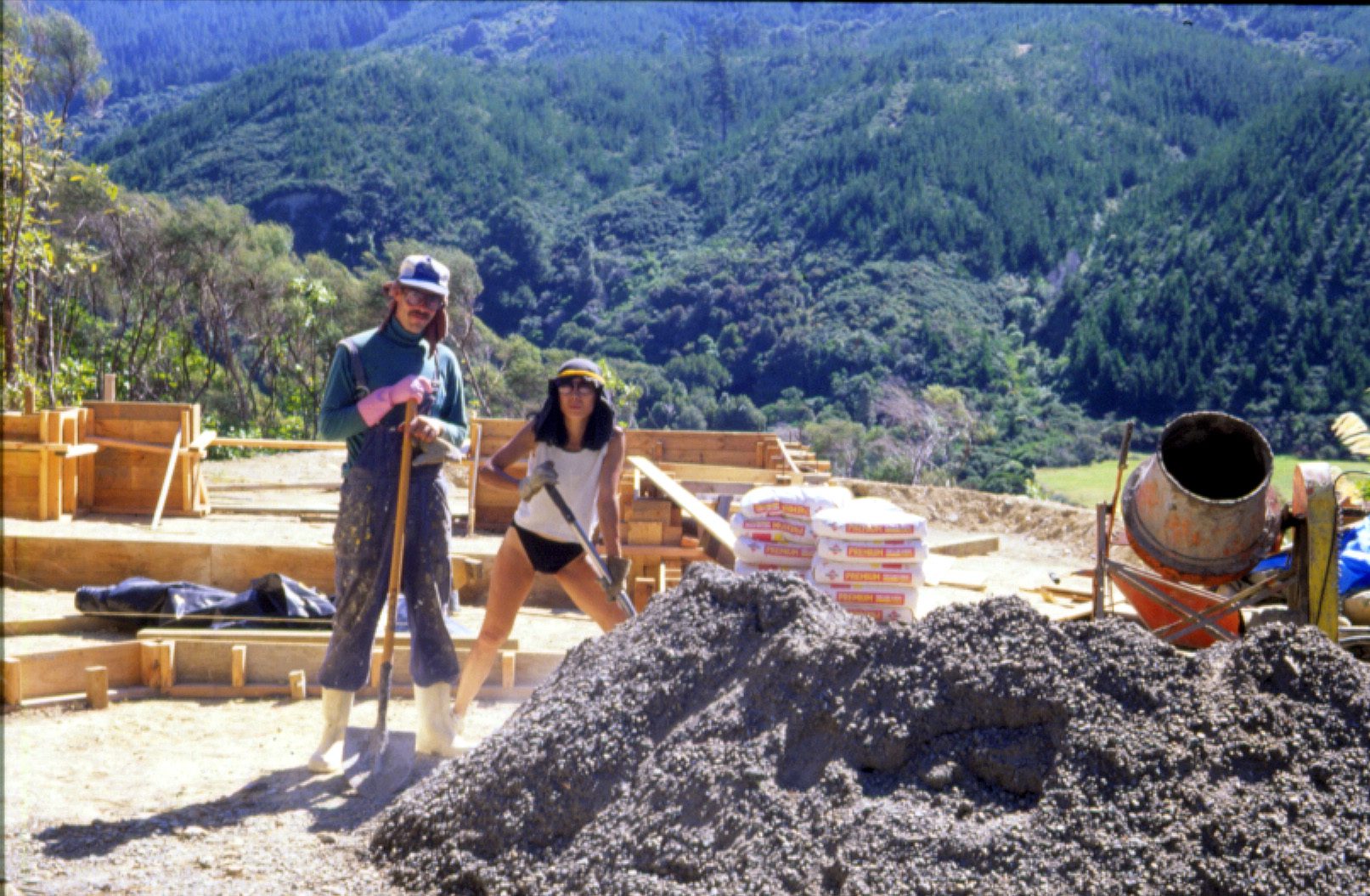
Peter and Hilda decided to build their house themselves. He completed the plans, consulted with local authorities, and brought the project to life on the hillside as an “isolation and insulation retreat.”
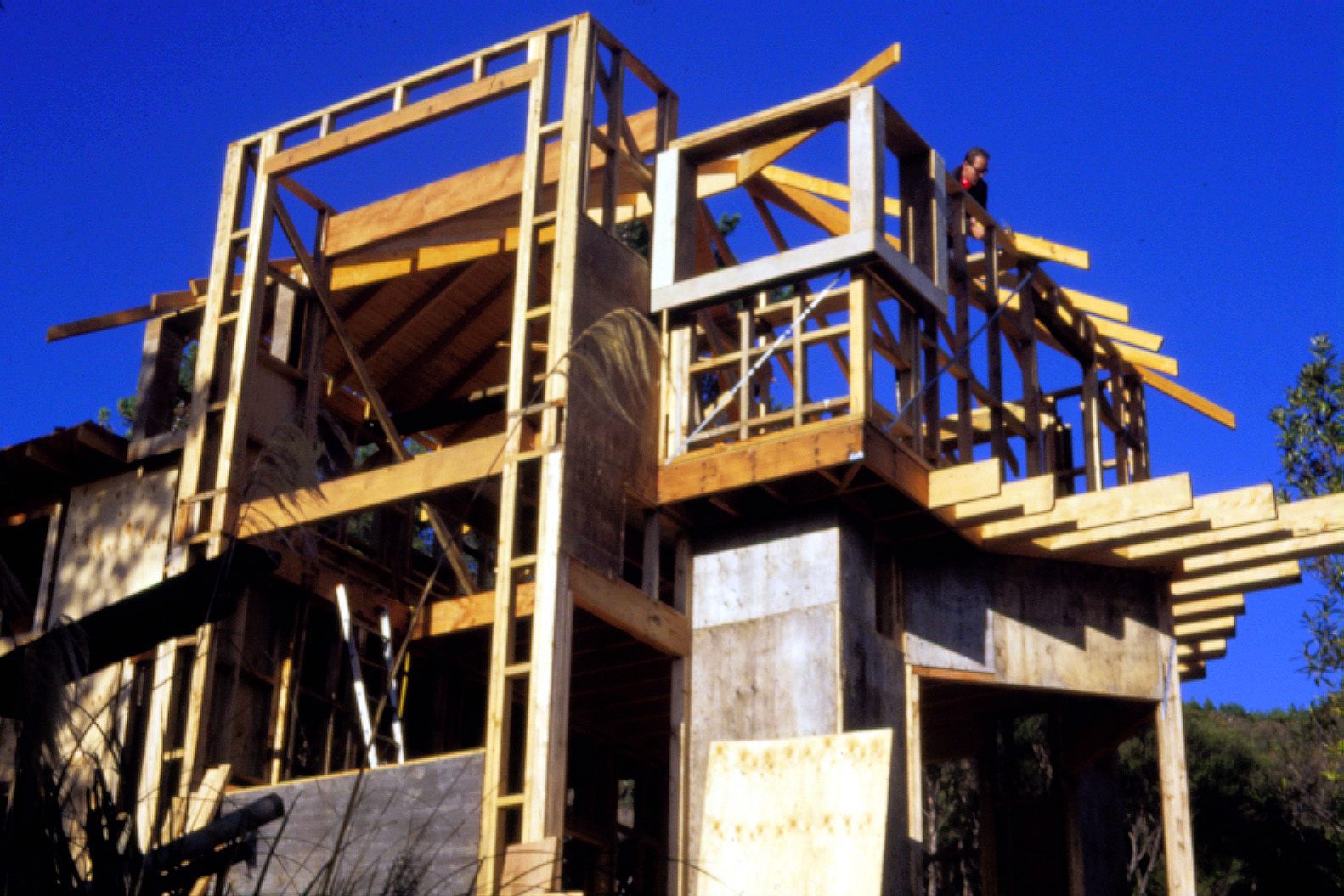 Learning woodworking from a carpenter who joked that he built a house over the phone, Peter, with his jeweller skills, constructed everything from foundations to kitchen, bathroom, cupboards, and shelves. The angular yet organic house blended into its woodland surroundings, with weathered timber planks and battens linking the house from the earth to the sky. “I love it here!” Peter exclaims, feeling the energy of the hillside.

Outside, native trees flourish, and the Akatarawa River flows over its river stones. Peter feels the native forest, with its ancient species, is young compared to the forests of the Netherlands. The New Zealand bush has a freshness and clarity absent in Europe’s oak and pine forests.
Jewellery takes shape on a wooden bench in his workshop just below the rooftop, where he works with pliers and a wide array of tools. A jeweller needs a strong wooden bench to hammer metal and sand it after scorching it with molten metal.
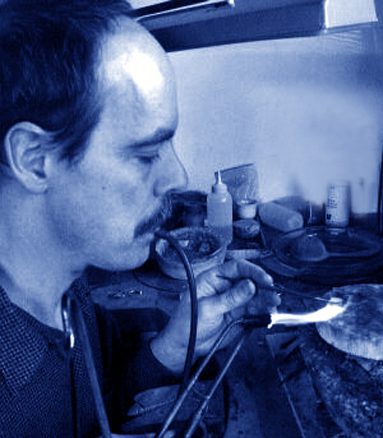 Peter prefers using a French torch, supplying oxygen with his own lungs rather than relying on a conventional high-pressure system. This gives him finer control over the heat and fosters a symbiotic relationship between the torch and his body. The flame adjusts based on what needs to be soldered.
The smell of oxidising metal can be strong in the workshop. Making jewellery can be a dirty process. “I love working with gold,” Peter says. It has a wonderful colour, can be drawn out or beaten, doesn’t oxidise, and fuses beautifully with a nice shine. However, the destructive mining for it can be an issue.
What does he think about silver? “Silver is different. I use it the most because it is affordable. When working, it oxidises into firestain, which is hard to remove. I have a love/hate relationship with it.
Akatarawa, together with Whitireia, has been a lodestone for his work since the seminal ‘Environmental Distortions’ show. When away from Whitireia, Peter devotes himself to making contemporary jewellery for small national and international exhibitions. At the same time, he has continued his studies, earning a Master of Fine Arts at Elam in Auckland. He has exhibited widely and was represented in the last three New Zealand Jewellery Biennales at the Dowse Art Museum, Lower Hutt.
DECKERS AND THE EARTH
Where does Peter’s work belong? New Zealand or the Netherlands? New Zealand is where he has laid the foundations for his home in the forest. He calls himself “a real Kiwi with a Dutch accent and Dutch attitude.” If he were to return to the Netherlands, he says, he would find himself “in no-man’s land.” Yet his work is more appreciated outside New Zealand. Rotterdam and the Netherlands continue to shape his work significantly.
His childhood and early career are a kind of emotional, intellectual, and artistic quarry. Techniques and perceptions he learned early on keep reappearing in more sophisticated ways. For example, Peter likes to display some pieces as room installations, a subtle development from his early career in window dressing.
Peter’s interest is to experiment with the display of his work in contexts away from the body. A planned presentation offers a neutral background compared to the flexing and crinkling of a living body. This might be an ironic nod to the modernist architects who prioritised heroic aesthetics over the practical needs of ordinary people when rebuilding Rotterdam.
In his birthland, jewellery is uptight, while in his adopted homeland of New Zealand, it tends to be earthy. Nature, such as land, flowers, trees, and birds, provides sources of colour, line, and shape. However, there is a preference for indigenous elements rather than cultivated ones. New Zealand artists often seek mythic or symbolic meanings in native flora, turning away from the suburban and urban environments where most people live. This romantic leaf-and-fern nationalism has evolved into an often equally romantic environmentalism today.
Peter critiques this as potentially cheap sentimentality, seeing the earthy nationalistic project as limited, provincial, and even propagandistic. He seeks depth, honesty, and severity, appreciating heritage but with a keen instinct for authenticity. “New Zealand jewellery is interesting and nice,” he says, “but not always exciting enough to connect with people throughout the world.”
He believes the people have learned much from their relationship with the indigenous landscape and each other. Māori perspectives have brought new meaning to the lives and perceptions of others in New Zealand. Peter values the symbolic nature of Māori art, contrasting with the abstraction central to contemporary European art jewellery. New Zealand has taught him to be more relaxed and playful, with life seeming less scripted than in the Netherlands. “The word ‘must’ doesn’t fit well into the New Zealand vocabulary,” he notes.
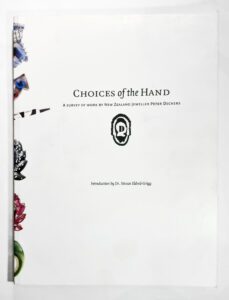 from: CHOICES of the HAND, A survey of work by New Zealand Jeweller Peter Deckers, 2006, text by Dr Stevan Eldred-Grigg