
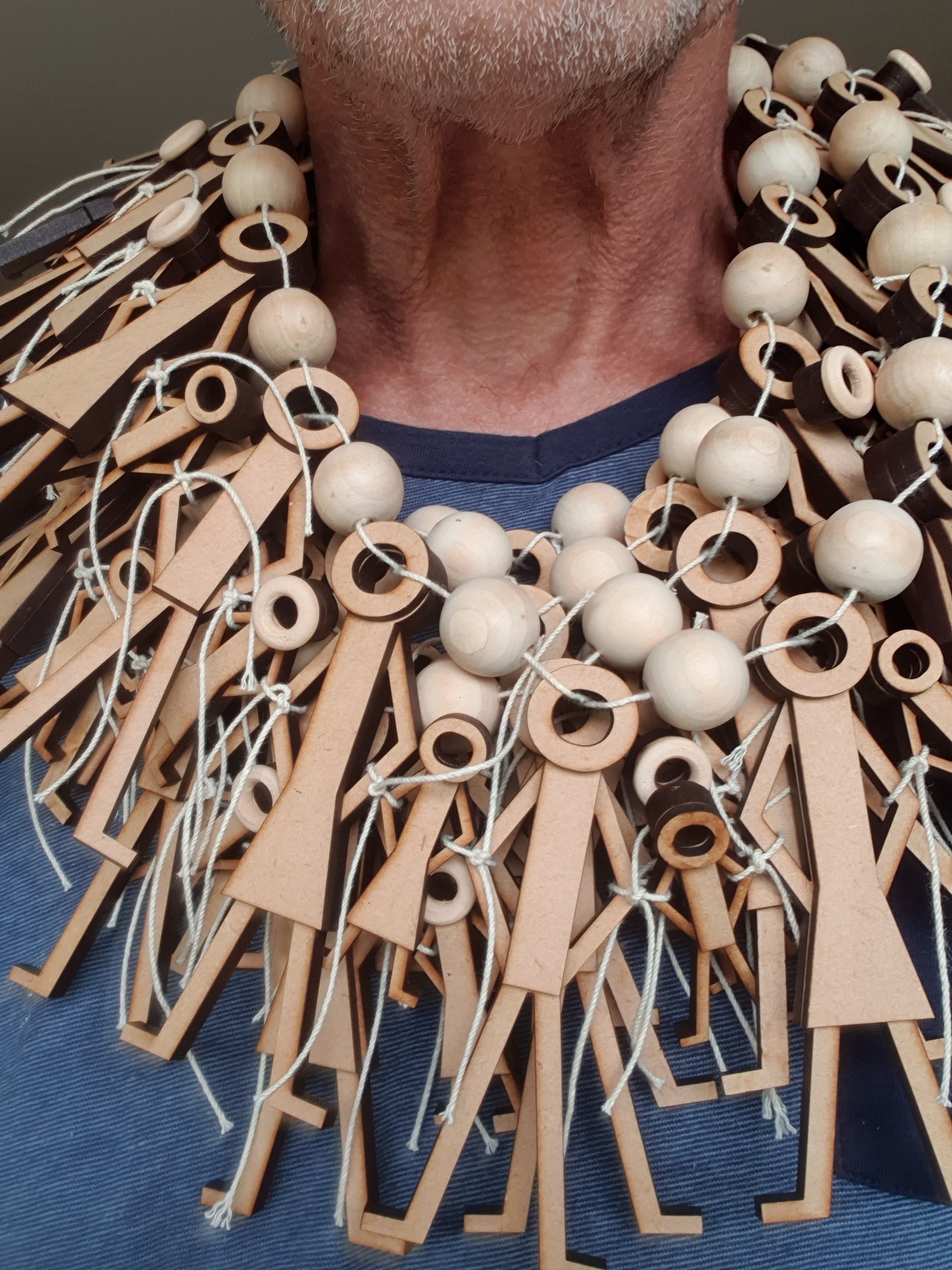
ONE ODD ONE OUT, 4 necklaces, 2020, recycled MDF, pine beads, cotton

ONE ODD ONE OUT, 3 necklaces, 2025, recycled MDF, pine beads, cotton

GOODNESS exhibit, Munich 2025: ONE ODD ONE OUT, 3 necklaces, 2025, recycled MDF, pine beads, cotton, brooch by Raewyn Walshm Garment by Munich fashion school student
ONE ODD ONE OUT, 4 necklaces, 2020, recycled MDF, pine beads, cotton
THE CONFLICT LOOP
Conflict behaves like a mirror system: a set of surfaces angled toward one another until they generate their own horizon. What begins as a response to danger becomes a structure that reflects itself, feeding on anticipation rather than events.
Economic studies show that defence spending produces the lowest return of all public investments. Education, health, and infrastructure generate more jobs, more stability, more long-term prosperity. Yet the defence budget expands because the system is not designed to optimise well-being. It is designed to sustain its own reflection.
The loop forms through a familiar sequence:
- a threat is projected,
- capability is expanded,
- industry grows around that expansion,
- political identity grows around that industry,
- and the projected threat returns, now magnified by the system built to address it.
Each layer confirms the next.
Each reflection strengthens the image.
The loop accelerates because it operates on short cycles: annual budgets, quarterly profits, election seasons. Meanwhile, the systems that produce cultural prosperity — learning, care, ecological repair — move slowly, accumulating value over decades. They do not generate urgency. They do not generate spectacle. They do not generate fear.
Conflict does.
Conflict loops.
Historical patterns show that the largest surges in military spending occur not after attacks, but after shifts in imagined risk. The loop thrives on possibility. It does not require war, only the expectation of war. Expectation is enough to keep the mirrors aligned.
This is why the loop feels inevitable from the inside: it reflects only what confirms its necessity. Everything else — the long horizon of education, the quiet work of health, the slow repair of climate — falls outside the frame. These are systems that do not mirror back quickly. They do not amplify. They do not accelerate.
They are occluded by the brightness of the loop.
BREAKING THE LOOP
Loops break when they encounter something they cannot absorb — a form of reality that does not reflect back. Research into institutional change shows that entrenched systems collapse not from critique, but from incompatibility.
Three forms of incompatibility stand out:
A threat that cannot be weaponised
A meteorite, a super-volcano, a climate cascade — events that do not respond to force. They reveal that security is not only defence, but resilience, cooperation, and shared vulnerability.
A redefinition of security itself
When security becomes the capacity to sustain life rather than the capacity to dominate, the loop loses its central mirror. Its reflections no longer align.
A new economic engine
When another sector becomes more profitable, more politically stabilising, and more culturally resonant than defence, the loop begins to dissolve. Its gravitational pull weakens.
THE REVEAL
Seen through Looping Mirrors, conflict is not an aberration.
It is a perceptual machine: a system that generates the conditions for its own continuation.
Inside it, narratives become instruments. Propaganda is not merely persuasion; it is the loop speaking to itself, reinforcing the angles of the mirrors. It tells a population what to fear, who belongs, and where loyalty should be placed. Over time, people begin to work for the loop without recognising the recruitment. They become its operators — administrators, commentators, voters, workers — each performing a small part of the machinery.
As the loop strengthens, the field of acceptable thought narrows.
Critique becomes suspect.
Ambiguity becomes dangerous.
Alternative viewpoints are treated as threats to cohesion rather than contributions to understanding. The loop rewards alignment and punishes deviation — sometimes overtly through law and policy, more often through social pressure, reputational risk, and the quiet withdrawal of opportunity.
Control emerges not as a single act, but as a gradual tightening of the perceptual frame.
People learn what can be said and what must remain unspoken.
They adjust their language, their affiliations, their expectations of one another.
The loop trains them to anticipate consequences before they speak, to self‑edit, to stay within the safe brightness of the dominant narrative.
This narrowing is not experienced as coercion.
It feels like common sense.
It feels like safety.
It feels like belonging.
Meanwhile, the loop draws resources from the slow systems — education, health, climate repair, social care — and redirects them toward the fast cycle of anticipation and control. As these slower systems thin, so does the social fabric. Trust weakens. Kindness becomes harder to sustain. Fear becomes easier to trigger. A society living inside the loop begins to mirror its own anxieties back to itself, mistaking the loop’s reflection for reality.
What interrupts this machinery is not opposition, but a shift in attention — a widening of the frame, a recognition that prosperity emerges from slow, relational systems that do not loop quickly enough to dominate the political imagination. These systems cannot be weaponised. They do not produce spectacle. They require patience, continuity, and forms of cooperation that the conflict loop cannot metabolise.
The conflict loop is powerful because it is fast, bright, and self-reinforcing.
It breaks when we attend to what is slow, diffuse, and life-sustaining.
When the mirrors are no longer aligned around fear, the image dissolves.
What remains is the possibility of a different architecture — one that reflects not urgency or domination, but continuity, reciprocity, and the long work of sustaining life; an architecture future generations will recognise as the moment we stepped out of the loop.