
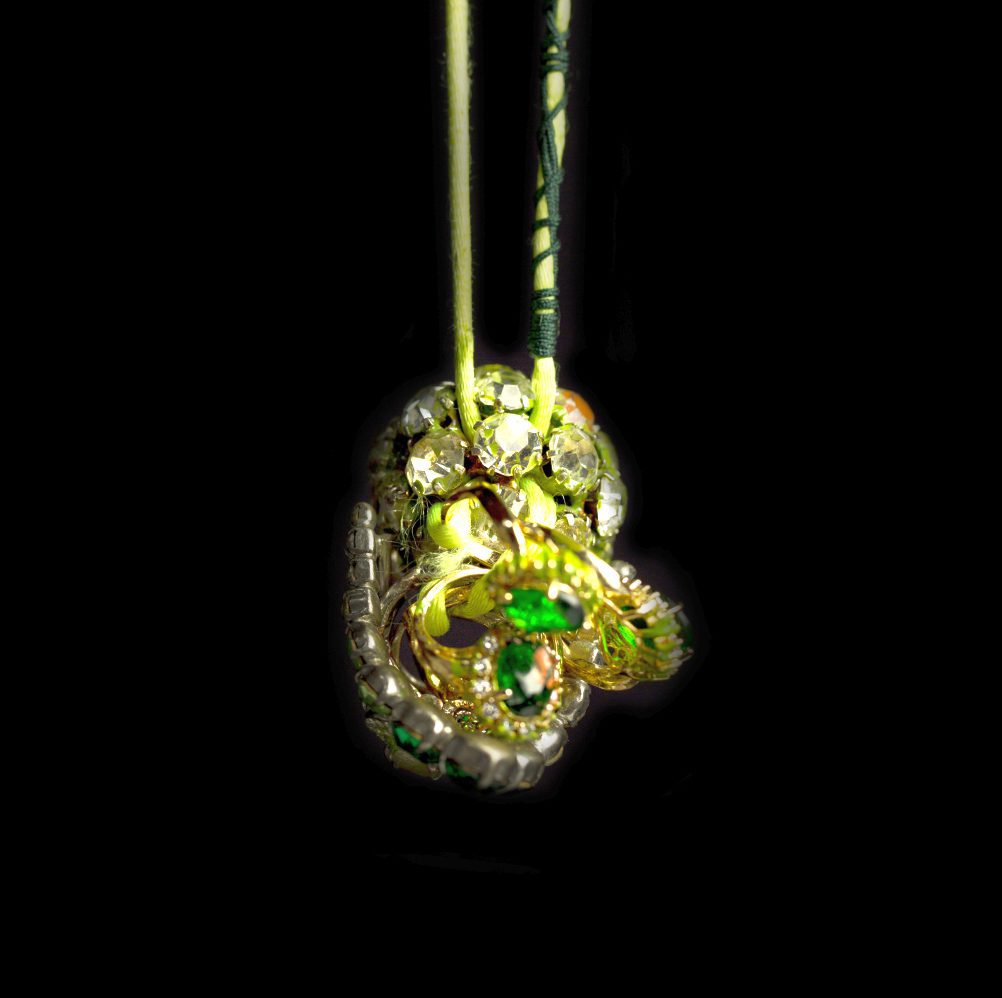
Load: pendant, 2024, costume jewellery emerald rings, paint (50 x 60 x 350mm)
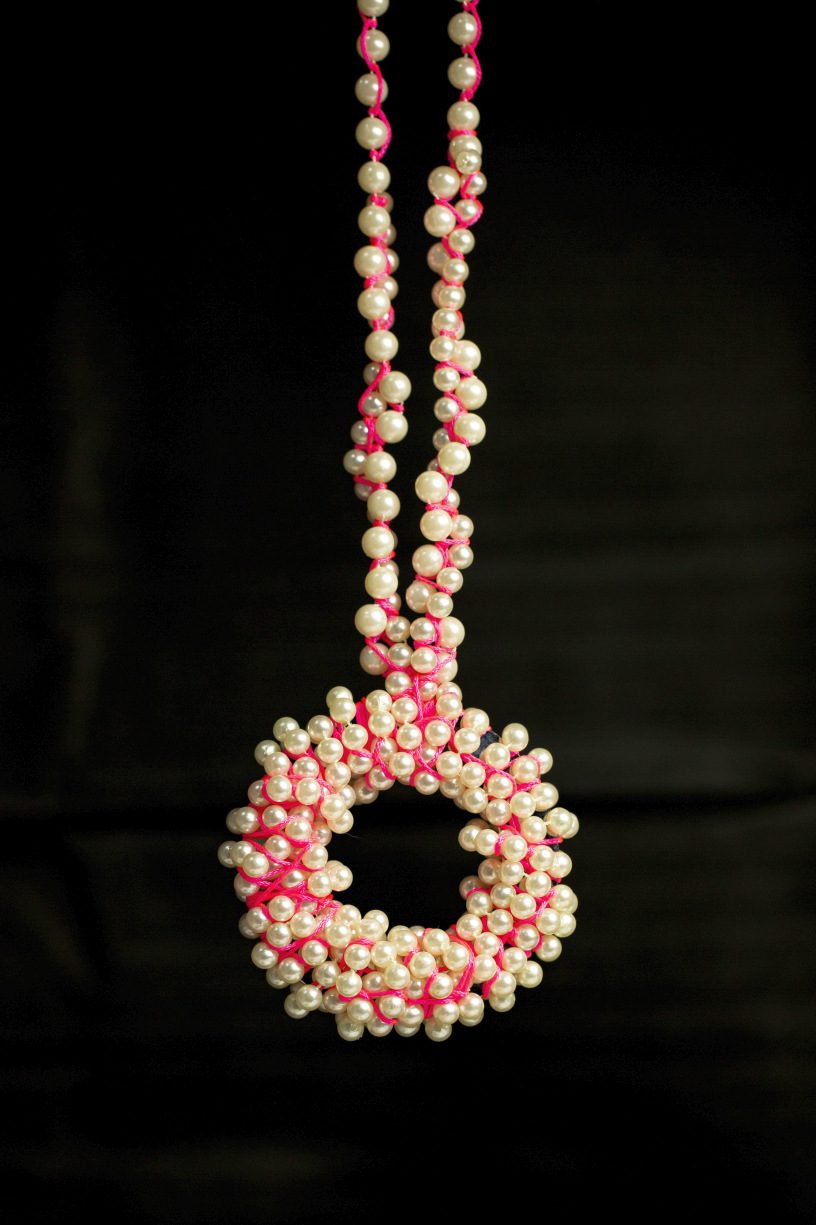
Artificial Universe2: chain/pendant, 2024, fake pearls, hard drive, builders line (100x30x450mm)

ZONE 22, necklace with pendant, 2025, meteorite, simulated pearls, st silver, Kumihimo braiding,
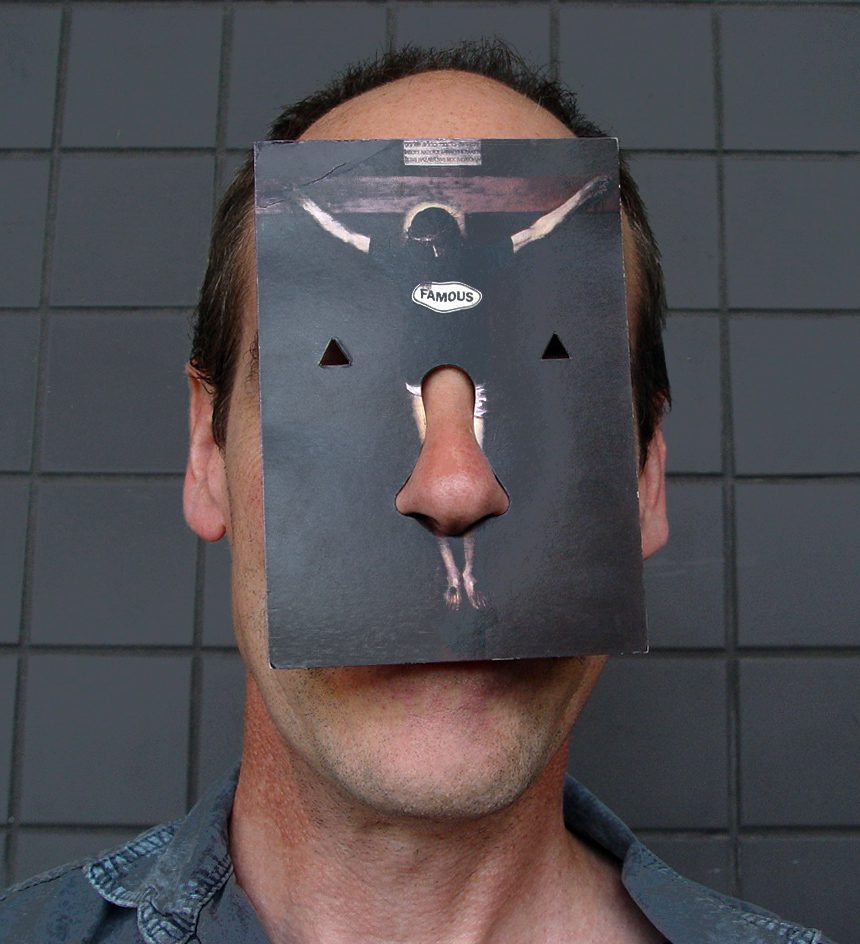
WHO NOSE, 2003, Otto Kunzli, postcard selected and worn by Peter Deckers, Pataka Museum

Hand to Eye, (nail from the cross) pendant, 2001, sterling silver, string
Smoke and Mirrors: Signs of Conflict
Every society begins with a simple hope: that people can live together in ways that feel fair, breathable, and responsive. A place where voices matter, where disagreement carries no fear, and where institutions adjust when reality shifts. A healthy system breathes through openness; nothing is perfect, but nothing is sealed. Borders exist, but they are porous — lines that regulate, not confine.
Pressure gathers long before conflict appears. Systems tighten quietly — a little fear here, a repeated story there — until one narrative becomes the only one safe to believe. Soft borders harden. The present stops mirroring lived experience. The system listens less, responds less, sees less. Conflict begins not with violence, but with accumulated strain: widening inequality, environmental exhaustion, political exclusion repeating through the recursive logic of power. What was once a boundary becomes a barrier.
Reality is never a clear pane. It is a mirror assembled from events, bent by propaganda, tilted by ambition. What is reflected is not what is true, but what is repeated. Smoke and mirrors deepen the distortion until reflection itself becomes unreliable. Perception becomes a border — a line between what people are allowed to see and what they are allowed to believe. What looks like a mirror is already warping the world; what looks like smoke is already the hint of fire.
Small sparks widen under the weight of interconnected systems. A drought, a price spike, a border crossing — each can cascade into global tremors. Climate change intensifies every fault line, pushing communities toward migration, reshaping economies, and tightening loops of pressure across borders. Geopolitics responds unevenly. Some leaders call for cooperation; others amplify fear to consolidate power. The world tilts depending on who controls the narrative and who benefits from confusion. Internal borders — resentment, exclusion, distrust — spill outward when systems can no longer absorb the strain.
Humanity can unite instantly when the threat is unmistakable — a meteor would dissolve borders overnight. But destabilising forces rarely look like meteors. They arrive through elections, through promises, through the narrowing of what people are allowed to see. They shield themselves with smoke and mirrors, reframing reality until hesitation itself becomes pressure. The border between truth and illusion becomes a political instrument.
Technology accelerates this drift. Tools built for connection are repurposed to divide. Algorithms amplify outrage; surveillance becomes governance; noise becomes censorship. Digital borders — once invisible — become the new architecture of control. A society persuaded that safety requires obedience becomes one where dissent feels dangerous, even disloyal.
Authoritarianism no longer needs armies. It thrives through networks, data, and the architecture of attention. Democracies, vulnerable to the same pressures, tighten almost imperceptibly into regimes of exclusion and control. The border between democracy and authoritarianism is no longer a wall; it is a gradient.
We live in a moment where many forces converge: economic strain, climate disruption, technological acceleration, geopolitical rivalry, mass displacement, and a global population unsure of whom to trust. Pressure accumulates until it finds release — sometimes reform, sometimes collapse.
Systems under strain rarely drift toward openness. They tighten, distort, and search for release. So the questions return:
When does pressure tip perception into distortion? When does fear become a society’s organising principle? How much strain can a world hold before it chooses a path of no return?
And most urgently: How do we recognise within ourselves the border that tightens in fear — and the border that insists on staying open to possibility?

TARGET, brooch, 2020, hard drive, copper, bullet case, sealing wax

PEACE MAKERS, pendant, 2009, bullet cases, laminates, st silver, copper, komuhimo braiding silk