

POINTERS – GOOD and BAD: What We Point Toward
Before we speak, we point.
From the near touch of Adam and God — a gesture read as creation, longing, obedience, or divine selection depending on one’s beliefs — we inherit the idea that a point can carry absolute meaning. Yet even this iconic moment is ambiguous: who is pointing, who is receiving, and who is excluded from the exchange?
A pointing gesture feels ancient, but its meaning is never universal. Our arrows — from the archer’s bow to the directional signs that structure modern life — arise from specific histories of hunting, warfare, and instruction. Even the gold plaque sent into deep space carries an arrow meant to show direction, though it may be unreadable to beings without an archery culture. What seems self‑evident to us may be invisible, or meaningless, to others.
This gap reveals something significant: pointing is never neutral. It carries the weight of the systems, histories, stories, and assumptions that shaped it.
 To understand our history — and avoid repeating its mistakes — we need ways to raise awareness and ask urgent questions. The act of pointing becomes a method of noticing: a small tilt of attention toward what usually passes unquestioned. It draws the eye to the places where good and bad blur, where certainty falters, and where the seen and unseen trade positions. In these moments, questions begin to surface — not only about what we point at, but about the systems that taught us to point in the first place.
We once relied on shared pointers — journalists who checked facts, scientists who cross‑referenced evidence — to help us navigate uncertainty. But when these systems lose authority, the ground shifts. In their absence, suspicion spreads quickly. Accusation becomes easier than understanding. It is the same reflex that once fuelled witch-burnings: certainty without knowledge, judgment without proof. The forms are modern, but the pattern is old.
The terrain is slippery. Good leans into bad; good intentions fold into harm — not through a single event, but through patterns that loop and return until they feel natural. Yet these same loops can also carry the seeds of renewal. Renewal is not inherently virtuous; it can unsettle, confuse, or fracture, creating openings for both liberation and division. Virtues such as care, courage, or liberty can accumulate force, forming patterns that loosen what has become too tight — but they can also overextend, tipping into excess or unintended harm. As these patterns settle, they begin to shape the systems around us, and those systems, in turn, generate their own mirrors: cultures of tightness or looseness that reflect the very conditions that formed them.
This is also the terrain of the I Tjing: yin tipping into yang, yang softening into yin, change as the only constant. The I Tjing reminds us that balance is never still; the moment something reaches its peak, the first signs of its reversal are already present. Every state carries the seed of its opposite. When a pattern becomes too tight, it ruptures; when it becomes too loose, it dissipates. In both cases, the system loops back on itself, forming new conditions that will eventually tilt again.
The pointer form — the didactic finger — is one of the oldest tools of moral instruction. It directs attention, assigns meaning, and divides the world into what should be followed and what should be avoided. Yet the moment we point toward “good” or “bad,” the categories begin to wobble. What begins as virtue can accumulate heat, pressure, or righteousness until it ignites negative reactions. What appears as vice can fracture open and reveal unexpected clarity, connection, or possibility. These recursive movements mark the moments when appearance diverges from reality, when intention drifts from outcome, when moral certainty falters and the unseen begins to surface. They gesture toward the stories we inherit, the systems we move through, and the judgments we carry — often without noticing how those same systems loop back and shape the environments of our perception again.
Rather than offering answers, this text attends to the recurring cycles of inversion and return. Each pointer shape indicates, redirects, and reveals — not to instruct, but to unsettle. It invites consideration of how vice becomes virtue, how virtue becomes vice, and how the act of pointing itself participates in the very loops it tries to control.

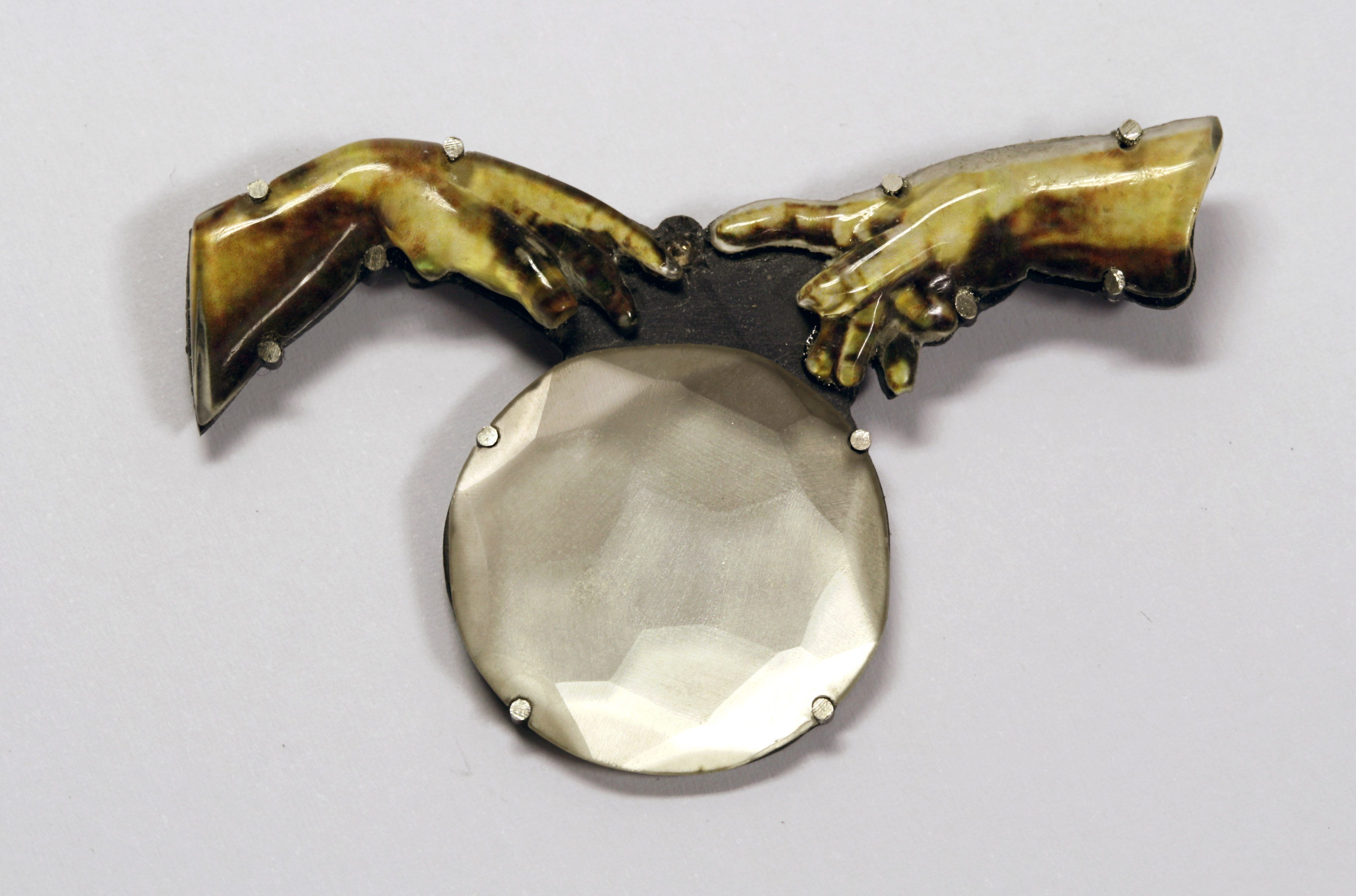
Ricochet, 2001, brooch, famous good and bad people, St Silver, print, crystal glass
POINTERS in VICE and VIRTUE

VICE & VIRTUE pointers, brooches, 2008
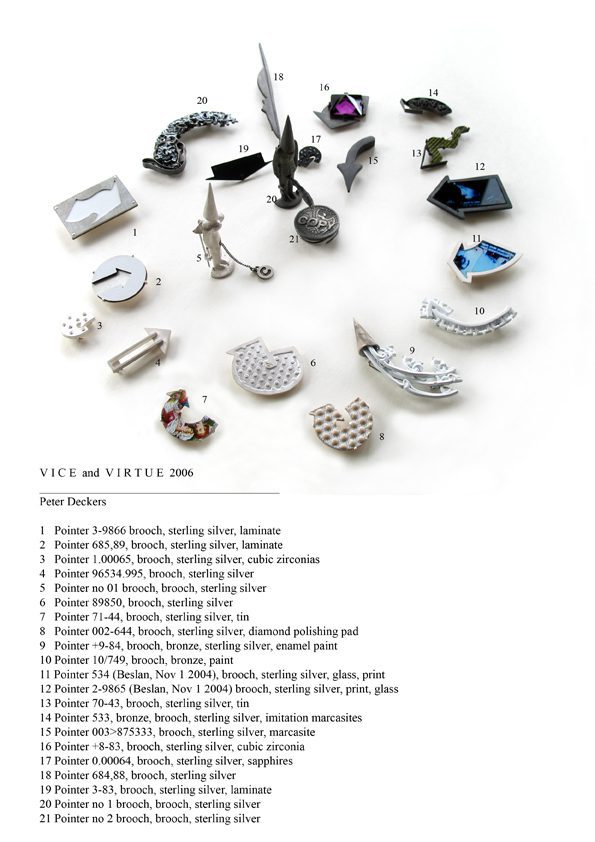
The didactic finger
This body of work reflects on how good and bad are perceived, presented, controlled, and carried — and on the motives that sit beneath those judgments. It raises a set of questions: What is actually going on, and where does each of us stand within it? Is a vice or virtue actual, factual, or virtual? How much of each — and in what order?
From a neutral standpoint, I observe the “good in bad” and the “bad in good,” which immediately opens questions about what we call good or bad, what is myth, what is construct, and what is real or merely perceived as real. These boundaries blur further when culture, social pressure, rewritten laws, and the machinery of persuasion — from education to marketing to propaganda — reshape our sense of what is acceptable.
When everyone participates in the same behaviours, the categories lose clarity; confusion becomes normalised. Regimes long used fear, repetition, and control to tilt moral judgment in their favour, making the binary of good and bad feel unstable, even suspect. These tensions are experienced on every level of life. And when terror becomes real, even the smallest remark of beauty can act as a reminder of “the good,” easing its threat or misery for a moment.
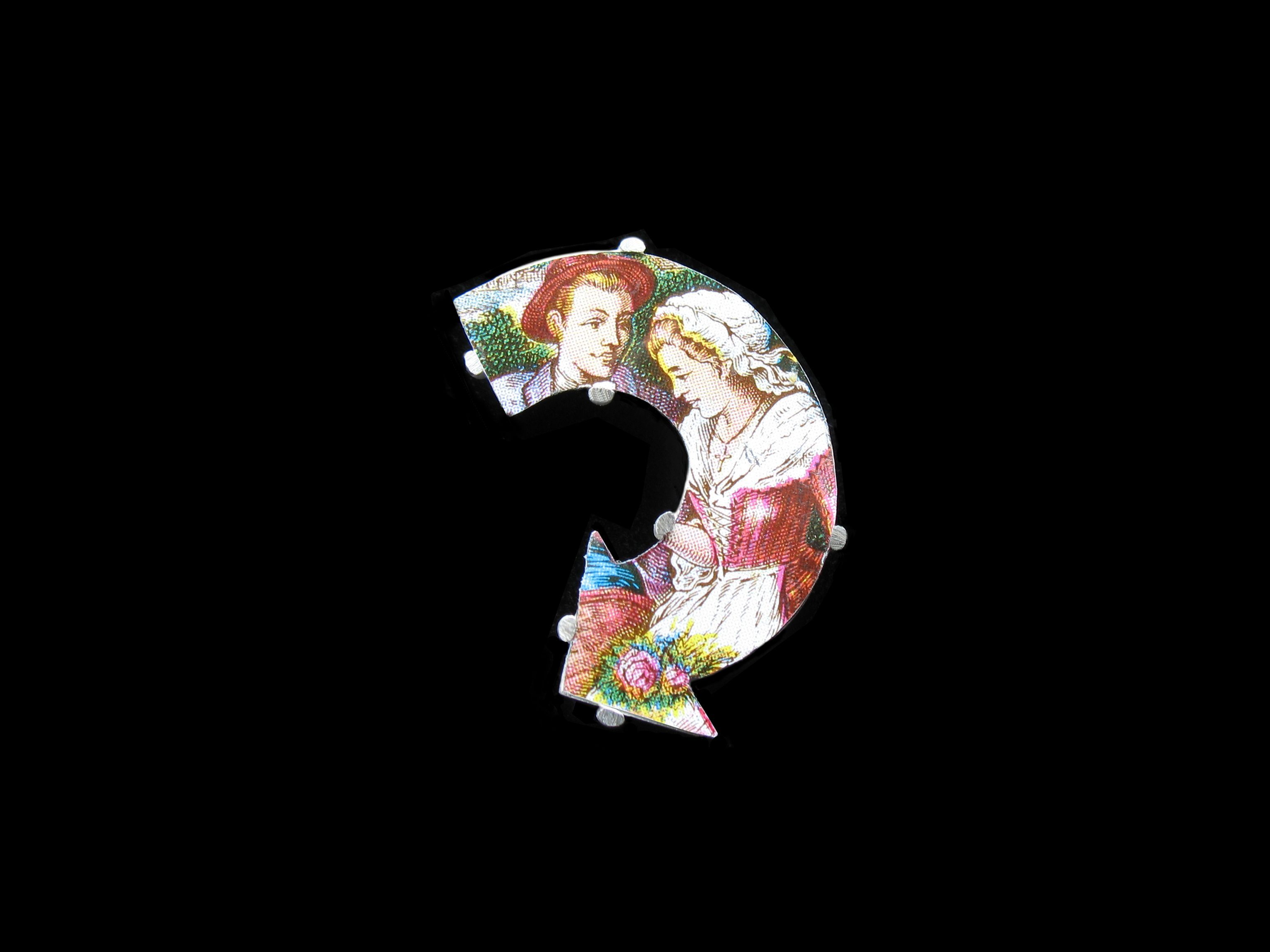
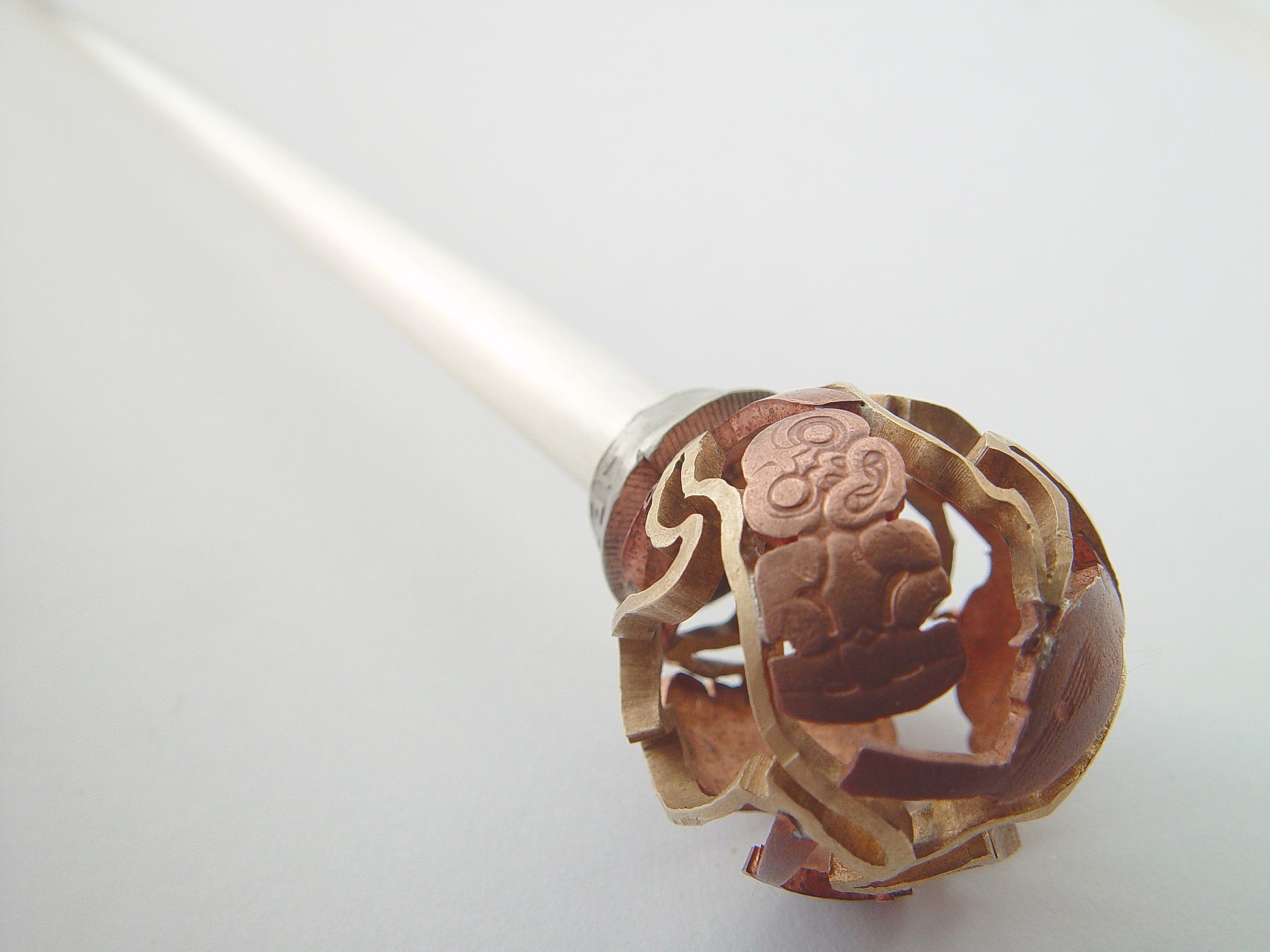
My work does not reveal who or what is wrong or right. POINTERS in VICE & VIRTUE uses only arrows and monochrome colours, symbolising the many challenges we face when criticality knocks on our door. The pointer — the didactic finger — directs attention, assigns meaning, and divides the world into what should be followed and what should be avoided. Yet the moment we point, the categories begin to wobble.
This project becomes a décor of reality that inspires some, but it also exposes the inherent disjunction in our perceptions of vice and virtue — the gap between what we believe, what we are told, and what we actually see.
It invites viewers to consider how easily moral certainty can shift, how appearances diverge from intentions, and how the act of pointing itself participates in the very loops it tries to control.







THE ARCHITECTURE OF VICE AND VIRTUE
How power shapes behaviour, and how the moral compass bends
Injustice is often felt in the body before it is understood. It doesn’t start in the mind; it starts in the stomach — that unmistakable tightening, a quiet alarm that something is wrong even when others insist everything is justified, necessary, or righteous. That split in perception is not a misunderstanding. It is part of the architecture that shapes how societies function and how people behave. The same architecture that produces saints and tyrants, carers and predators, reformers and enforcers.
This architecture hides inside familiar language. Harm is done in the name of law, security, justice, tradition, discipline, religion, and defence. These words sound virtuous. They reassure. They stabilise. They make actions appear moral even when the consequences fall on the vulnerable. The Didactic Finger points, instructs, corrects — and in doing so, reveals how easily authority can claim virtue while enacting vice.
The moral compass is imagined as universal, but it is anything but. Each person’s compass is tuned differently. Some feel harm first; others feel disorder first. Some respond to suffering; others to rule‑breaking. Some prioritise freedom; others prioritise safety. Under pressure, these differences widen until two people can witness the same event and inhabit opposite moral worlds. One sees cruelty; another sees necessity. One sees suppression; another sees protection. The compass becomes a contested instrument.
Power understands this. It uses the language of virtue to mask the mechanics of control. Justice becomes punishment. Law becomes obedience. Security becomes pre‑emptive force. Tradition becomes exclusion. Order becomes silence. Vice dresses itself as virtue, and virtue is dismissed as weakness. This is the terrain of Vice and Virtue: the unstable boundary where moral certainty becomes a weapon.
But the architecture doesn’t begin with institutions. It begins in childhood, in the loops of nature and nurture. Temperament meets story. Sensitivity meets reward. Trauma meets belonging. Present meets history. A child raised in fear may learn domination as survival. A child raised in care may learn responsibility as identity. A sensitive child may become a healer — or a target. An ambitious child may become a leader — or a tyrant. People do not simply choose good or evil; they follow the loops available to them.
And these loops don’t form in a vacuum. They are shaped by the conditions a person is born into — privilege or precarity, safety or threat, belonging or exclusion. Nationality, race, gender, wealth, schooling, health, and the wider systems of law, labour, housing, and care all tilt the ground beneath a person’s feet. Environmental pressures, political instability, economic downturns, corruption, pollution, and the slow violence of inequality all shape how a life unfolds. These forces don’t determine a person, but they shape what is possible, what is blocked, what must be survived, and what remains out of reach. They decide which loops open and which loops close.
And from these loops, another force takes shape: calling — an intuition shaped quietly by circumstance and experience, formed at the intersection of inner patterns and outer pressures long before anyone notices.
Some people feel drawn toward care, others toward creation, others toward discovery, others toward leadership — and others toward the physical or strategic, where the body or the mind reads patterns faster than thought. We call this talent, but talent is rarely a gift from nowhere. It is a convergence: temperament, curiosity, opportunity, encouragement, repetition, practice, and the quiet permission to follow what feels meaningful. An artist is often someone who has absorbed histories, patterns, and ways of seeing until intuition becomes a tool. A nurse is often someone who learned early to notice suffering. A scientist is often someone who learned to question. A leader is often someone who learned that their voice could move a room. These are not accidents. They are the long shadows of early loops.
And then there is charisma — the wildcard in the architecture. Charisma bends the loops. It accelerates them. It gives certain people an almost gravitational pull. Charisma is not goodness, nor is it evil. It is amplification. It makes the fair more trusted, the tyrannical more feared, the unjust more tolerated, the suppressed more visible, the creative more contagious, the destructive more thrilling, and the kind unforgettable. Charisma gathers crowds. It turns personal conviction into collective momentum. It can lift people toward compassion or sweep them into cruelty. In the architecture of vice and virtue, charisma is the accelerant — the spark that turns a person into a symbol, a leader, a danger, or a hope.
These loops are reinforced by social pressure. Every society — from a family to a nation — uses rules, norms, shame, reward, and fear to shape behaviour. Used with empathy, they produce teachers, carers, artists, and citizens. Used with fear, they produce bullies, enforcers, opportunists, and ideologues
And fear doesn’t only produce bullies and enforcers. It produces collaborators — ordinary people who align themselves with power because it feels safer than resisting it. Collaboration rarely begins with conviction. It begins with self‑protection, with wanting to belong, with not wanting to stand out. It begins with small acts: staying silent, looking away, passing on a rumour, reporting a neighbour, following a rule without questioning its purpose. Most collaborators are not driven by ideology but by pressure, fear, habit, or the desire to be seen as “good” within the system they inhabit. They become the eyes and ears of authority, not because they believe deeply, but because they are afraid not to. Collaboration is the architecture’s most efficient mechanism: it turns citizens into instruments, neighbours into monitors, communities into networks of surveillance. It is not the monsters who make systems dangerous. It is the everyday people who decide it is safer to comply
And woven through all of this is the question of action — or the absence of it.
Ruling orders often respond to injustice with delay, denial, or procedural language that protects the system rather than the people inside it. Inaction becomes a form of action. Silence becomes a stance. The refusal to intervene becomes a decision with consequences. When those in power do nothing, the architecture tilts toward harm by default.
On the other side lies revenge — the impulse to correct injustice with more injustice. Revenge feels like action, but it corrodes the moral compass. It replaces judgement with impulse, accountability with retaliation. It turns pain into justification. It makes vice feel like virtue. Revenge is the moment when the architecture collapses inward, when the loops that once guided us become loops that trap us.
Between inaction and revenge lies the most fragile force in the system: love.
Love is delicate because it requires vulnerability, and vulnerability is dangerous in environments shaped by fear, hierarchy, or suppression. Love can guide the compass, but it can also be exploited, dismissed, or weaponised. It can be the reason someone acts — or the reason someone stays silent. It can open the door to compassion — or to heartbreak that hardens into cruelty.
Action, inaction, revenge, and love are not separate from the architecture.
They are the currents that move through it.
They determine whether a society drifts toward care or collapses into harm.
They determine whether a person becomes a witness, a bystander, a protector, or a perpetrator.
This is why the patterns we see in global conflicts feel familiar. They are the same patterns we see in a controlling household, a rigid school, or a workplace where power is unchecked. The scale changes. The architecture does not. Power justifies itself. Fear distorts perception. Belonging overrides empathy. Rules become weapons. Virtue becomes a costume.
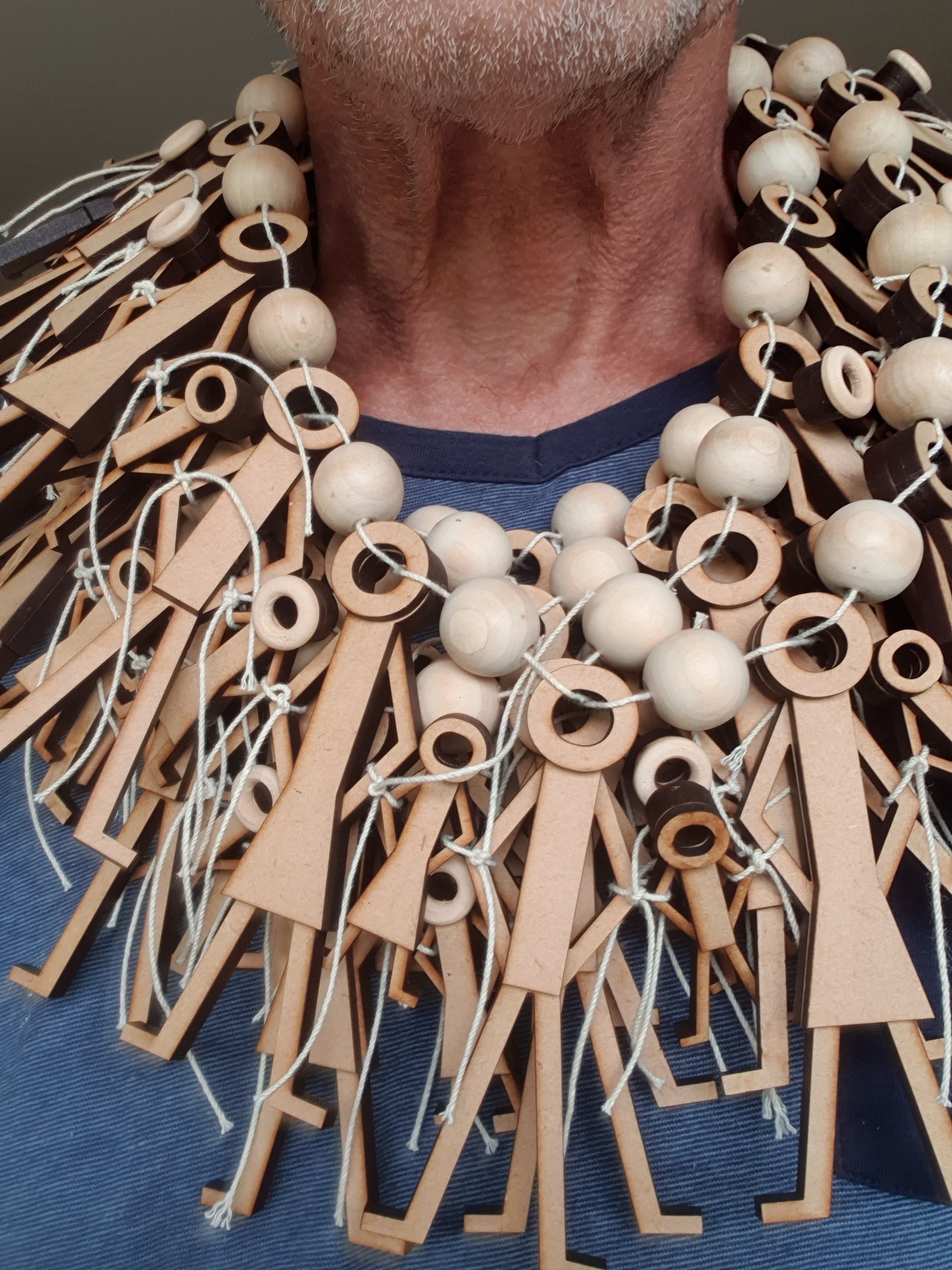
And yet, within this architecture, people still make choices — not free‑floating moral choices, but choices shaped by loops of fear, reward, identity, and story. Vice and virtue are not fixed traits. They are emergent behaviours. They arise from context, pressure, opportunity, and narrative. They are directional forces, like arrows. They point somewhere. They shape what we see, what we ignore, and what we allow.
The Didactic Finger exposes the gesture of authority.
Vice and Virtue exposes the instability of moral judgement.
What emerges is the architecture beneath authority and judgement — the forces that shape our instincts, tilt our perception, and steer our behaviour long before we notice them. Once seen, it doesn’t leave; it refuses to disappear. Naming it lets others recognise the same patterns in themselves and in the world around them.

HUMAN BEHAVIOUR: the loops beneath morality, identity, power, and choice
How Society Is Tested
A single gesture — a point, an arrow, a rule — can both guide and wound.
Vice and virtue aren’t opposites so much as twin forces emerging from the same underlying systems.
Across history, philosophers have returned to the same loop:
that virtue without examination becomes obedience,
that vice disguised as order becomes acceptable,
and that societies drift toward harm when people stop asking the most difficult questions.
Socrates framed it as the unexamined life. Arendt saw it in the machinery of conformity. Cornel West names it the normalisation of injustice. All point to the same danger: when we stop interrogating ourselves, we become instruments of the very forces we fear.
Socrates taught that the first act of courage is to question oneself. His challenge — “How should one live?” — was not a search for rules but a refusal to accept inherited certainty. He exposed how easily people mistake custom for truth, obedience for virtue, and comfort for moral clarity. This is the same terrain Cornel West walks when he asks, “How did I become so well adjusted to injustice?” Both insist that the unexamined life becomes a quiet collaborator with harm.
Societies are tested not only by moments of crisis but by the quiet drift toward short‑term consent. When fear rises, when uncertainty spreads, when the future feels fragile, people often accept what they would otherwise resist. Convenience becomes a substitute for conviction. Stability becomes more desirable than justice. The architecture tilts.
And in that tilt, West’s questions surface — not as doctrines, but as recognitions.
The first is the shock of self‑interrogation:
How did I become so well adjusted to injustice?
It reveals how easily brutality becomes normal when it is distant, disguised, or directed at someone else.
Then comes the pressure on integrity:
How shall integrity meet oppression?
A society that trades humanity for authoritarian comfort may gain order, but only briefly. The bill always arrives.
Honesty is tested next, quietly but relentlessly:
What does honesty do in the face of deception?
When propaganda and distraction shape public perception, truth becomes a form of resistance. Weak analysis produces weak citizens; sustained dialogue produces moral clarity.
And beneath everything lies the most difficult question of all — the one about love, not as sentiment but as the public shape of justice:
How do we face evil without becoming what we oppose?
A society that abandons love abandons its own future. Without it, suppression becomes acceptable, cruelty becomes efficient, and collapse is merely postponed.
Short‑term consent is always tempting. It promises relief, order, simplicity.
But it is a Cain‑like refusal — a turning away from responsibility, a refusal to see the other as kin. It does not progress; it only postpones the reckoning. And the cost is always paid later, and dearly.
To resist this drift is to refuse the loops that shrink our moral imagination.
It is to insist on humanity over fear, integrity over obedience, honesty over distraction, and love over despair.
These are the forces that keep a society from collapsing inward — and the forces your work points toward with every arrow.
The Beslan School massacre, 2004

Beslan School massacre, pointer brooches, 2005, st silver, print, glass
On 1–3 September 2004, armed militants seized more than 1,100 hostages at School No. 1 in Beslan, including over 700 children. The siege ended in catastrophic violence, killing at least 334 people, among them 186 children — the deadliest school attack in history.


Beslan kid. In the 2005 BBC documentary, a young boy survivor speaks about the Beslan school siege of September 2004 — an attack in which 186 of their schoolmates were killed by armed militants.


Beslan kids. In the 2005 BBC documentary, two young female survivors play together while speaking about the Beslan school siege of September 2004 — an attack in which 186 of their schoolmates were killed by armed militants.
“The photos for this ‘Pointer’ project were taken from my grainy TV while I watched, in horror, the BBC documentary that aired on BBC World in 2005.”

Pointers, (from L to R)
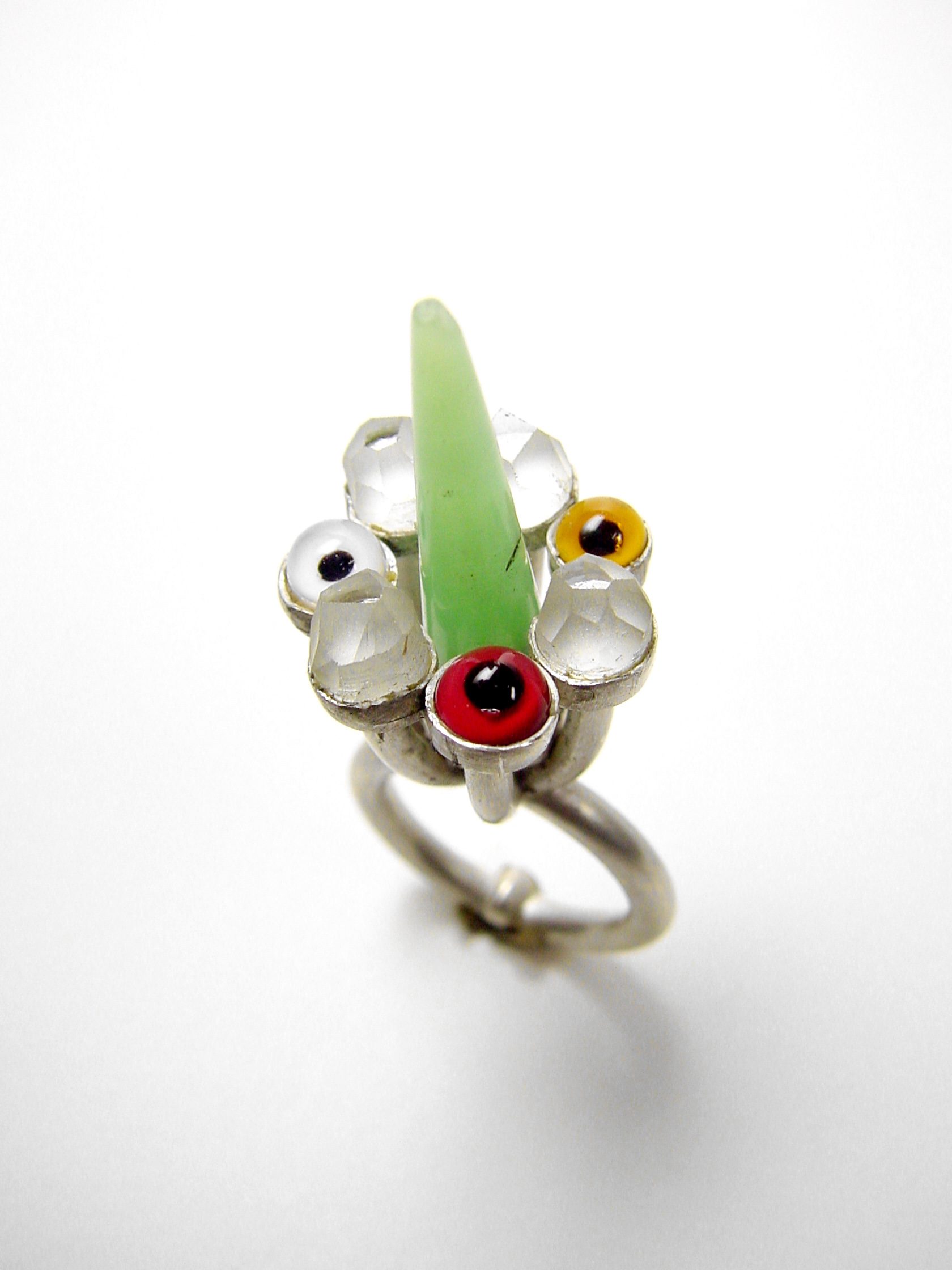
Eye Indicator, 2004, ring, st silver, chrysoprase, glass eyes, mirror
Pointer (b/w), 2004, earstuds, ebony, st silver
Pointer, 2003, St silver, glass animal eyes
Pointer, 2003, titanium, sterling silver

Tapaa Decent, lapel pin 1987, st silver, powder coated brass
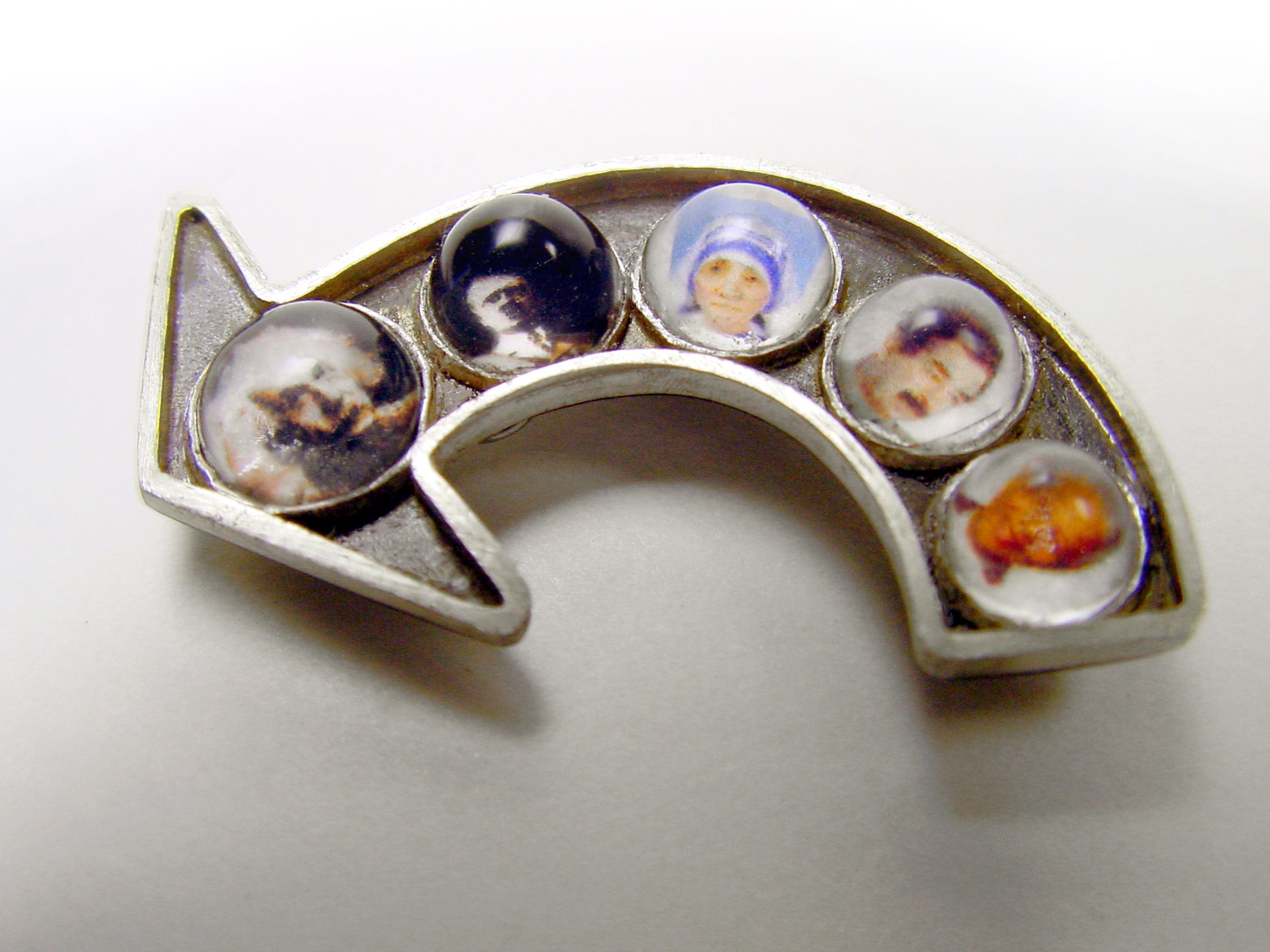
Ricochet, 2001, brooch, famous good and bad people, St Silver, print, crystal glass

Pointer, 2004, St silver, found tin with print

Beslan School massacre, back view

Ricochet, 2001, brooch back view

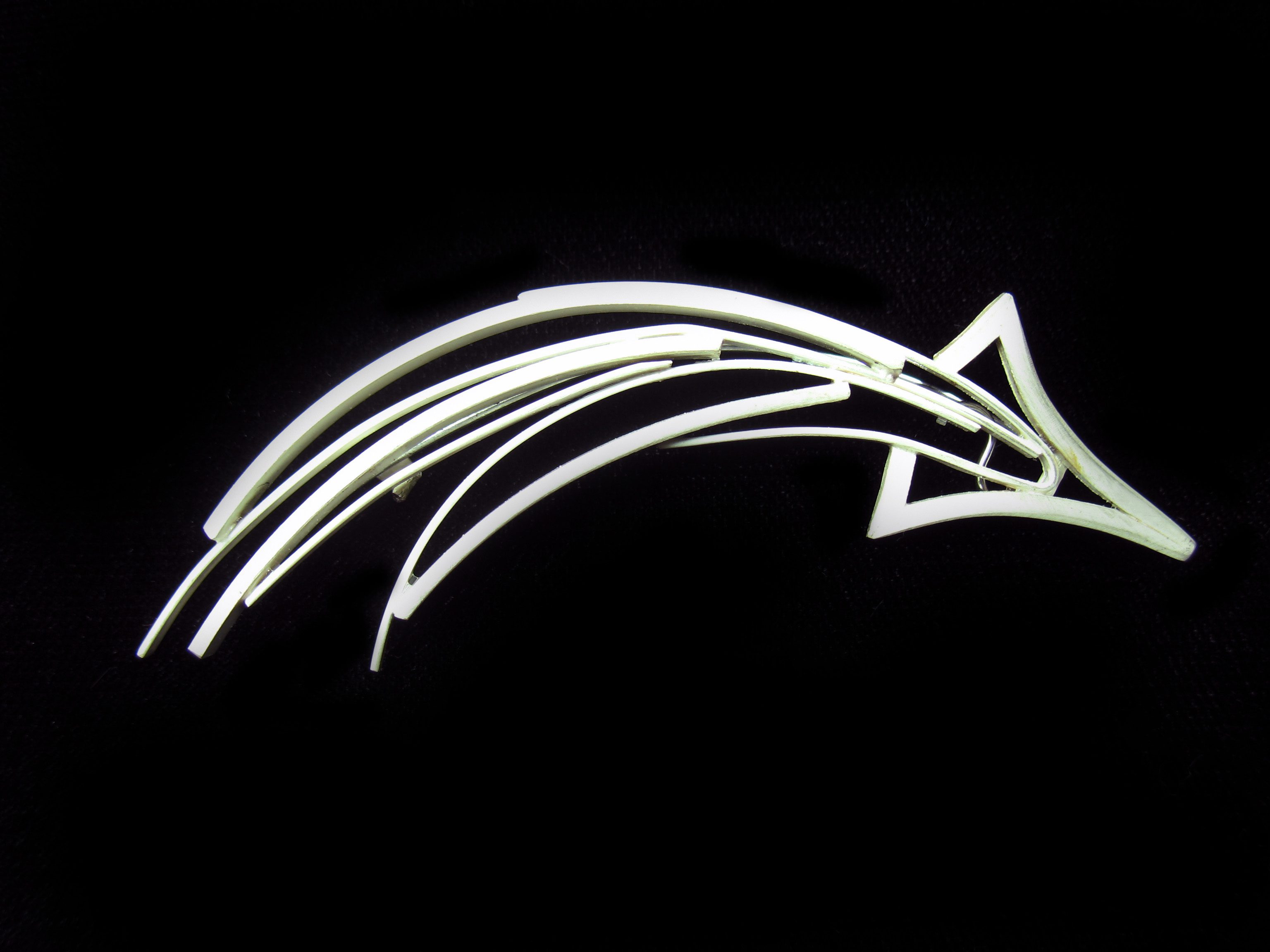
Pointer, 2005, St silver

Vice Pointer, 2005, double brooch with extra silver safety pin, St silver, graphite, marcasites
Pointer 2005, brooch, sterling silver

Eye Indicator, 2004, ring, st silver, chrysoprase, glass eyes, mirror
Vice & Virtue copyrighted copy, 2005, brooch series: sterling silver

Baby Hitler Tit ring, 2007, ring, sterling silver, print, mirror, crystal glass
The Baby Hitler Tit ring, 2007. This ring carries a photograph of Adolf Hitler as an infant. It reflects a neutral stance on the act of procreation and the human instinct to begin life with promise and hope. Every child enters the world in a state of innocence, held by caregivers who cannot foresee what that life will become.
This raises profound questions: What went wrong? Is it culture that overrides nature and alters people’s compassion, or is it something else entirely?
The mix of love and hate in one person challenges our understanding of morality, showing how good and bad traits coexist in one person, making it difficult to fully comprehend the influences that shape their actions and moral compass.

Two Points of Difference, 1989, bracelet, powder-coated copper, copper points