
ORIGINS
As an immigrant in a land of immigrants, Peter is profoundly drawn to the questions of origins. The concept of origins is inherently tied to language. An immigrant with a Kiwi accent is no longer perceived as an outsider, while an immigrant with stands out. New Zealanders are acutely aware of their ancestors and the journeys their forebears undertook from one part of the world to another. Interestingly, ancestry seems more alive in the young society of New Zealand than in the old one of the Netherlands.
“Māori have a very strong sense of identity,” says Peter, “and always link themselves back to their ancestry.” Even the Māori, often seen as the indigenous people of New Zealand, are descendants of relatively recent immigrants. By the time Dutch sailors first sighted Māori in the mid-17th century, they had been in New Zealand for about four hundred years. Almost all tribes spoke of their homeland before their journey to New Zealand, often referred to as Hawaiki.
Peter believes that the Māori awareness of ancestry has inspired other New Zealanders, particularly those of European descent, to explore their own family stories. European New Zealanders frequently discuss their origins or heritage and are usually very knowledgeable about them. “The common man here is interested in where he comes from, unlike in the Netherlands, where only the nobility seem to care,” he says. “The common man in the Netherlands lives for the present and the future.”
Peter feels his work has evolved thanks to this New Zealand focus on origins. Traditionally, jewellery design in the Netherlands has been dominated by the polished and symmetrical aesthetics of 19th-century neoclassical taste. While these elements are present in many cultures—Māori greenstone is polished, and Māori moko (tattoos) are symmetrical at first glance—Peter has noticed a difference in how traditions are discussed in various cultures. As a young jeweller, he was told in his culture, “We’ve always done it that way, don’t ask why.” In contrast, Māori traditionalists explain, “We’ve always done it that way, and this is why.”
The origins of traditions are alive in some cultures but forgotten in others. Origins, however, are not simple or solely rooted in memory. Immigration often means loss; roots once pulled up cannot always be transplanted into new soil. In his work, Peter explores how shifting from one’s origins to new destinations involves complex, sometimes liberating, sometimes bewildering exchanges, hybrids, dislocations, and fusions. He delves into the interconnectedness of identity, language, and culture. Through sound, ‘show windows’ and jewellery, Peter examines how immigration shapes not only the immigrant but also the future of the broader world of human society.
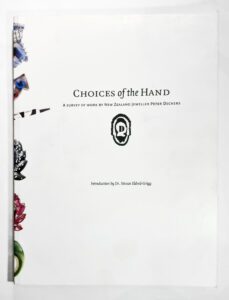 from: Choices of the Hand, A survey of work by New Zealand Jeweller Peter Deckers. Text by Dr Stevan Eldred-Grigg (2006)

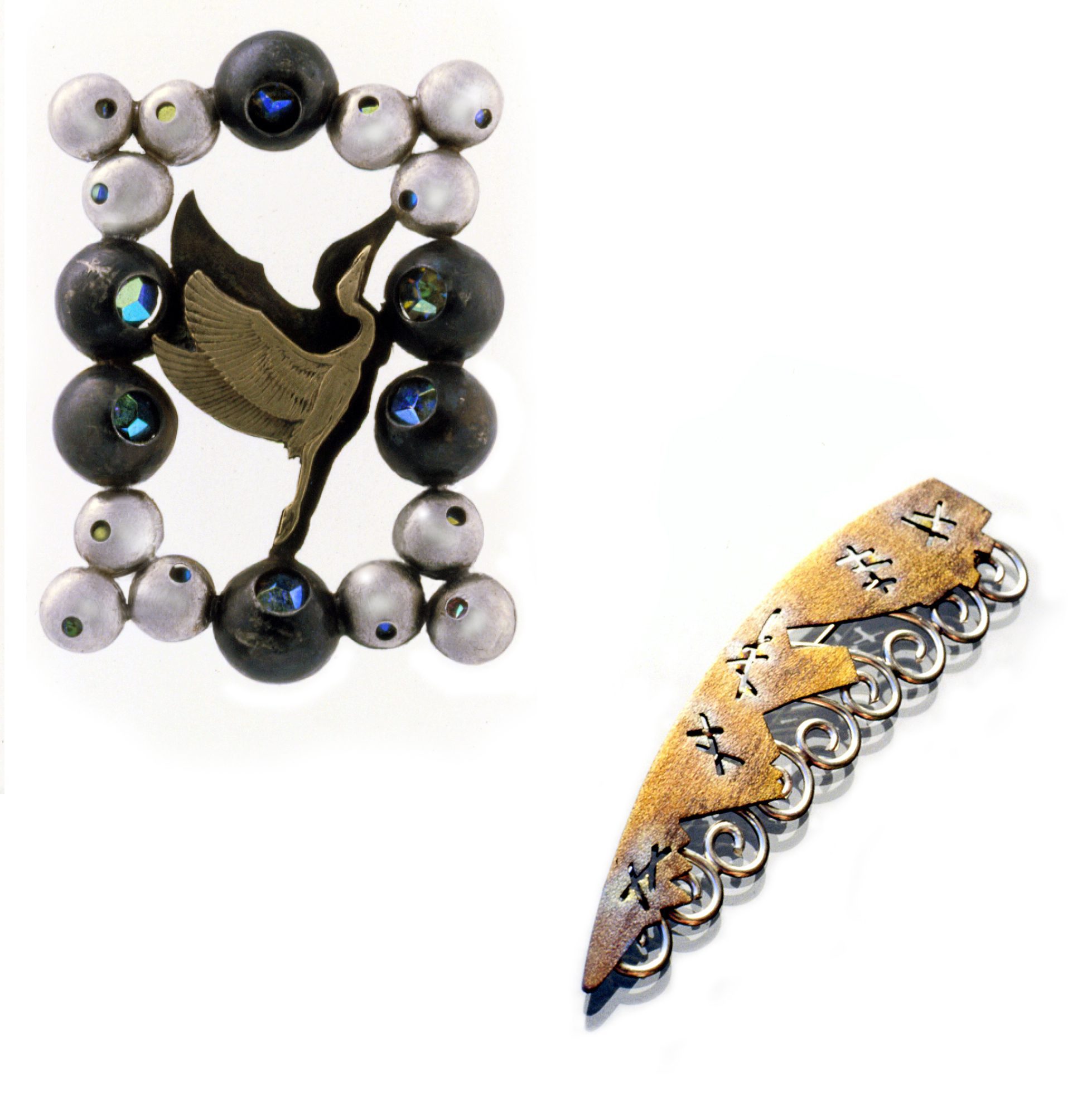
Immigrating is far from simple. Swapping identity is nearly impossible, making the process more about adoption and adaptation. In his early years in New Zealand, Peter crafted many flags and sails—flags symbolising identity and sails representing voyage.
This was not a conscious choice but rather an organic process that unfolded as he learned a new language, explored an adopted culture and its new surroundings, and celebrated the adventure and excitement of this liberating phase. These experiences opened up new horizons in jewellery making. New Zealand’s pioneering and liberating spirit perfectly matched the creative, idea-hungry young man.


THE MANY FACES OF BORDERS: Power, Confinement, Identity, and the Human Condition
Borders are often imagined as lines — territorial, political, cultural — but they behave more like shifting architectures that shape how people live, move, think, and endure. They emerge from colonisation, conquest, migration, fear, protection, and belonging, carrying the weight of historical narratives that determine who is considered inside or outside.
These architectures influence not only physical landscapes but also the psychological, digital, and emotional boundaries that form within communities: the quiet distances, the inherited suspicions, the unspoken thresholds that shape how individuals perceive themselves and others. They also extend into the unseen — the perceptual, cognitive, and metaphysical borders that lie beyond measurement yet continue to structure how reality is experienced.
The Many Faces of Borders examines borders in all their forms and considers how deeply they shape the human condition in the twenty‑first century. It integrates and synthesises:
- Historical borders — conquest, empire, colonialism
- Geopolitical borders — law, power, the weakening of international norms
- Psychological borders — loneliness, proxemics, digital withdrawal
- Digital borders — the mobile device as refuge, attention as territory
- Moral and epistemic borders — truth, propaganda, narrative warfare
- Unseen borders — the limits of perception, the architectures of the mind, and the crossings into worlds we can sense but not yet measure
This publication is a conceptual companion to my artistic practice — a standalone exploration of borders across the scientific, psychological, cultural, experiential, ritual, and philosophical domains. It extends the concerns present in my jewellery, installations, and research, offering a broader framework for understanding the architectures that shape contemporary life.
Download the full text (PDF)
Greetings from Māori-Land emerges from what it means to arrive in Aotearoa as an outsider — carrying memories, languages, and cultural origins that shift and blur over time.
The installation work (Auckland, 2004) brings together immigrant voices, personal objects, shadows, and bilingual sounds to bring into relation how identity is formed, unsettled, adapted, and remembered. Each silhouette, each whisper, each chosen object becomes a small anchor in the ongoing negotiation between where we come from and where we find ourselves. As a Dutch‑trained jeweller who migrated to New Zealand in the mid‑1980s, I was drawn to how stories attach to objects and how language shapes belonging. The installation asks how new roots form in a land already layered with histories.


Māori Renaissance
 In the 1980s, a new trend emerged among jewellery practitioners in New Zealand: exploring Aotearoa’s identity. Jewellery-makers began discovering and developing unique indigenous materials and the cultures of the indigenous Pacific region. The 1988 Bone, Stone, and Shell exhibition, for example, celebrated this material quest. This exhibition showcased the innovative use of these materials, highlighting how contemporary jewellers were incorporating them into their designs to create pieces that resonated deeply with New Zealand’s cultural heritage.
Jewellers were not only focusing on the materials but also on the stories and meanings behind them. This period marked a significant shift towards recognising and honouring the rich traditions and material use of indigenous cultures. The exploration of these themes allowed for a deeper understanding and appreciation of New Zealand’s diverse cultural landscape. This shift paved the way for a new generation of jewellery-makers who sought to blend traditional techniques with contemporary design, resulting in pieces that were both innovative and deeply rooted in New Zealand’s heritage.
 During that time, Peter got inspired and started delving into Māori identity by interpreting concepts of value and meaning. His intrigue deepened further during the Māori renaissance. The Treaty of Waitangi, declared in 1840, is a unique document reflecting the equal partnership between Māori and Pākehā. This document made Peter a proud Kiwi, inspiring him to create work that supported the Māori uprising in their battle for acknowledgement and rightful place. In this period of proliferation, Māori established their mana (prestige and authority) to the rest of the world through cultural rights, resulting in protected copyright claims and cultural safety. Consequently, it made everyone who was non-Māori uncomfortable to create work following a Māori signature ever since. Peter made designs in line with the unique Māori uprising.
 However, that raised the question of cultural appropriation. When do inspirations and interpretations cross the line into appropriation? Peter tried to navigate this delicate balance, ensuring that his work honours the Māori culture while avoiding misappropriation and respecting the sacred elements of their heritage. Nevertheless, it became clear that this was not his battle, and perhaps could be seen as another form of cultural colonisation.


Origins of Influence
The political trading expeditions of Columbus and Magellan set a global precedent for economic integration that reshaped local customs and behaviours. Today, the U.S. exerts immense influence, not just economically through the dominance of the dollar, but also politically. Countries like New Zealand navigate this dependency, aligning policies to maintain favourable relations and access international markets. It’s a complex narrative of power, compliance, and adaptation, showing how economic and political pressures have continuously shaped cultures throughout history.


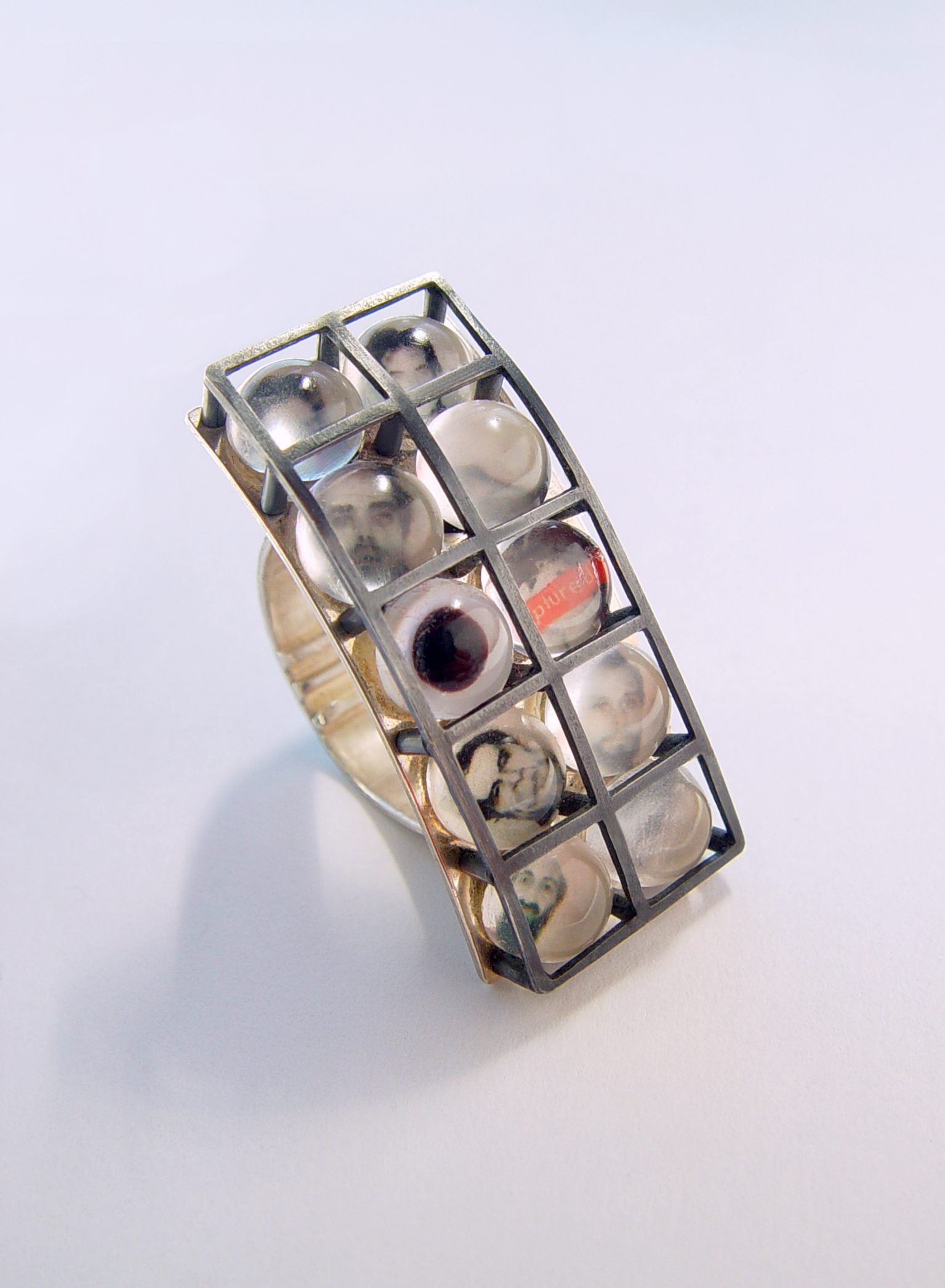

Death in Life
One’s identity is often rooted in personal heritage — family, ancestry, and the stories passed between generations. These origins live in objects as much as in memory. A ring, a necklace, a small possession can become an irreplaceable heirloom because it carries a person’s presence, their history, their place in the world.
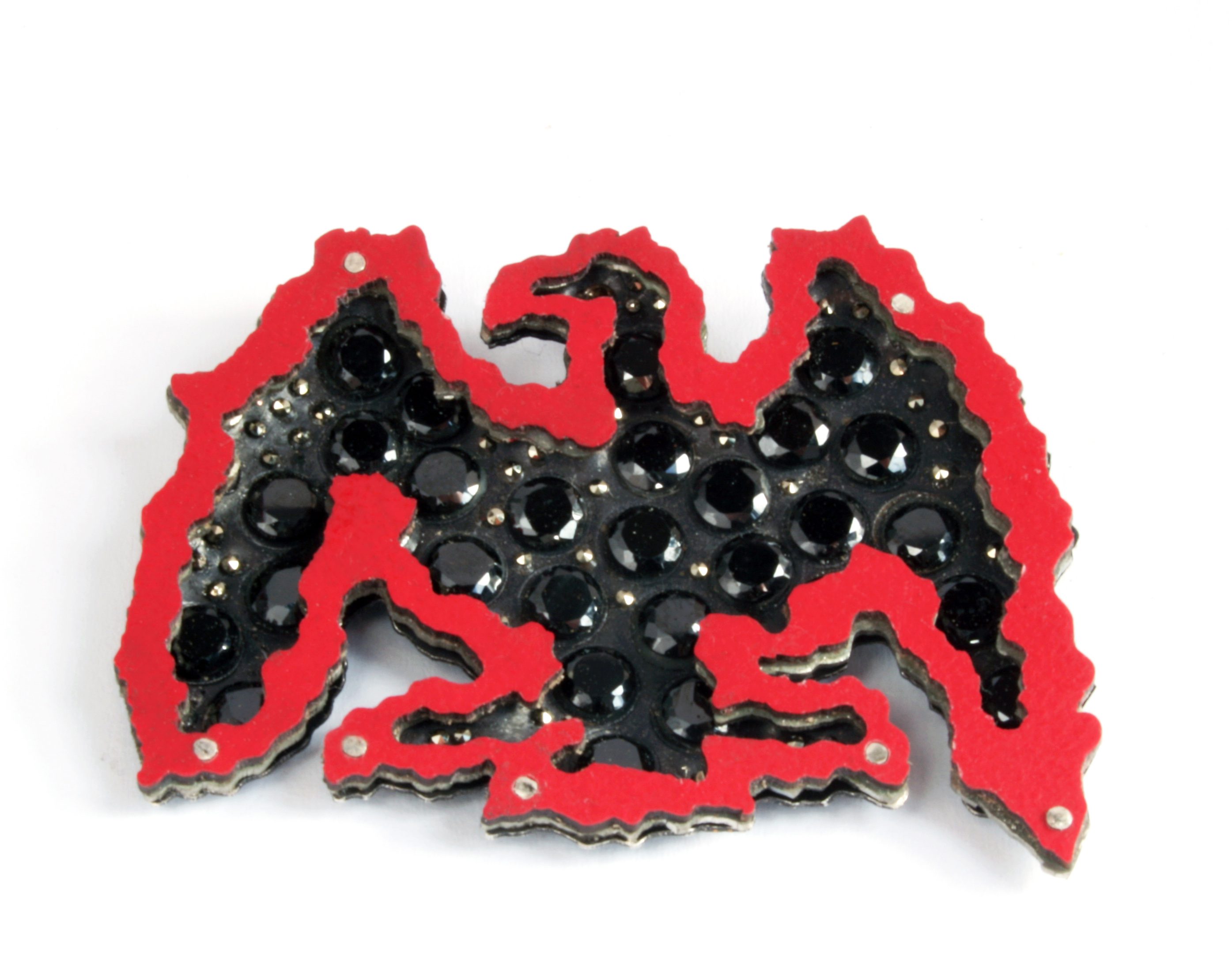
Most Wanted reworks this idea of what marks a memory. The ring holds nine images from the FBI’s Most Wanted list of the year 2000 behind crystal glass, alongside a glass eye from a collapsed stuffed extinct bird from Te Papa Tongarewa. It asks what constitutes a story worth remembering, and how objects preserve — or distort — the narratives we attach to them.
When the story behind an object is lost, its value collapses; when a story is unbearable, the object becomes its only container. In Japan, second‑hand kimonos are often avoided for this reason — the original connection is gone, leaving the garment unanchored. Objects gain meaning through the stories they hold, and lose it when those stories disappear.
The title Most Wanted carries a deep polarity. In everyday life, it names what we cherish — the person we cannot live without. Here, it refers to those capable of taking that loved one away. The same phrase holds two opposing worlds: devotion and devastation, memory and fear.
“Irreplaceable” is often linked to the recollection of people and their circumstances. When someone passes, a single object can become the vessel for their entire presence. A jeweller cannot control whether their creation becomes such a vessel; the wearer decides what story it must carry — love, grief, place, or the unresolved echo of loss.
The juxtaposition of the most‑wanted images with the glass eye of an extinct bird exposes how value shifts once a story is revealed. A gemstone can be precious or empty; a scrap of glass can become a relic. Most Wanted reveals how objects become vessels for both the cherished and the haunting, and how origins are preserved, transformed, or erased through the things we choose to hold.
(more).
Actual, Factual, Fictional (2000)

This work investigates the illusion of how people see their heirlooms and the stories they attach to them. It reveals the profound relationship between material objects and the narratives they carry, prompting us to consider the essence of what we hold dear and how these items become valuable vessels of our most cherished and haunting memories.
Stories have always been intrinsic to jewellery. Jewellery with a compelling story can create irreplaceable value, sparking the notion of ownership. This concept examines the processes and layers of ownership.
Peter, intrigued by this idea, recorded stories from local people about their heirloom jewellery. He documented their reflections on intrinsic values, the stories themselves, and the notion of ownership. This exploration culminated in a sound and jewellery installation titled ‘Now Then, Who Owns What?!’ The display features recordings of people discussing the significance of their jewellery.
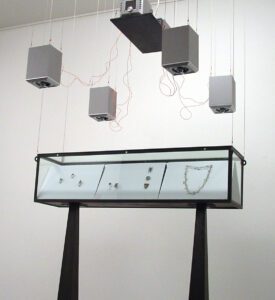
The installation showcases three rings, highlighting how different perspectives can be experienced of the same object. The first ring was found by Deckers in a second-hand shop, potentially carrying unknown stories. The second ring is a cast of the original, with its shapes and colours boldly accentuated to represent how others might perceive the ring in their mind’s eye. The third ring, also a cast, transforms the pearls into crystal-like forms of different shapes, materials, and colours, symbolising how the ring, with memories encased within it, might have been perceived by its previous owner.
Society Labels


Ans Westra wearing her Value Pack ring: sterling silver, lose silverbacked glass stones
 Societal labels, like “foreigner” or “citizen”, rely heavily on perception. Take Ans Westra: her photography has ingrained her into New Zealand’s national identity, earning her social “ownership” and acceptance despite her Dutch accent. Contrast that with someone attending a mosque who might face biases or invisibility in mainstream narratives, despite potentially sharing the same legal status as Westra.
When someone’s contributions to national identity are clear and celebrated, they’re more readily accepted. This form of social ownership often translates into broader acceptance, including their accent and cultural values. However, those outside these visible roles or practising different traditions might not receive the same welcome.
Belonging and acceptance are complex; it’s about societal perceptions and values. This perception of ownership determines whether someone is seen as a “citizen” or “foreigner,” reflecting the intricacies of societal biases and values.
 Immigrant’s roots are like shadows on the floor, from Greetings from Māori-Land