Peter Deckers
Peter Deckers
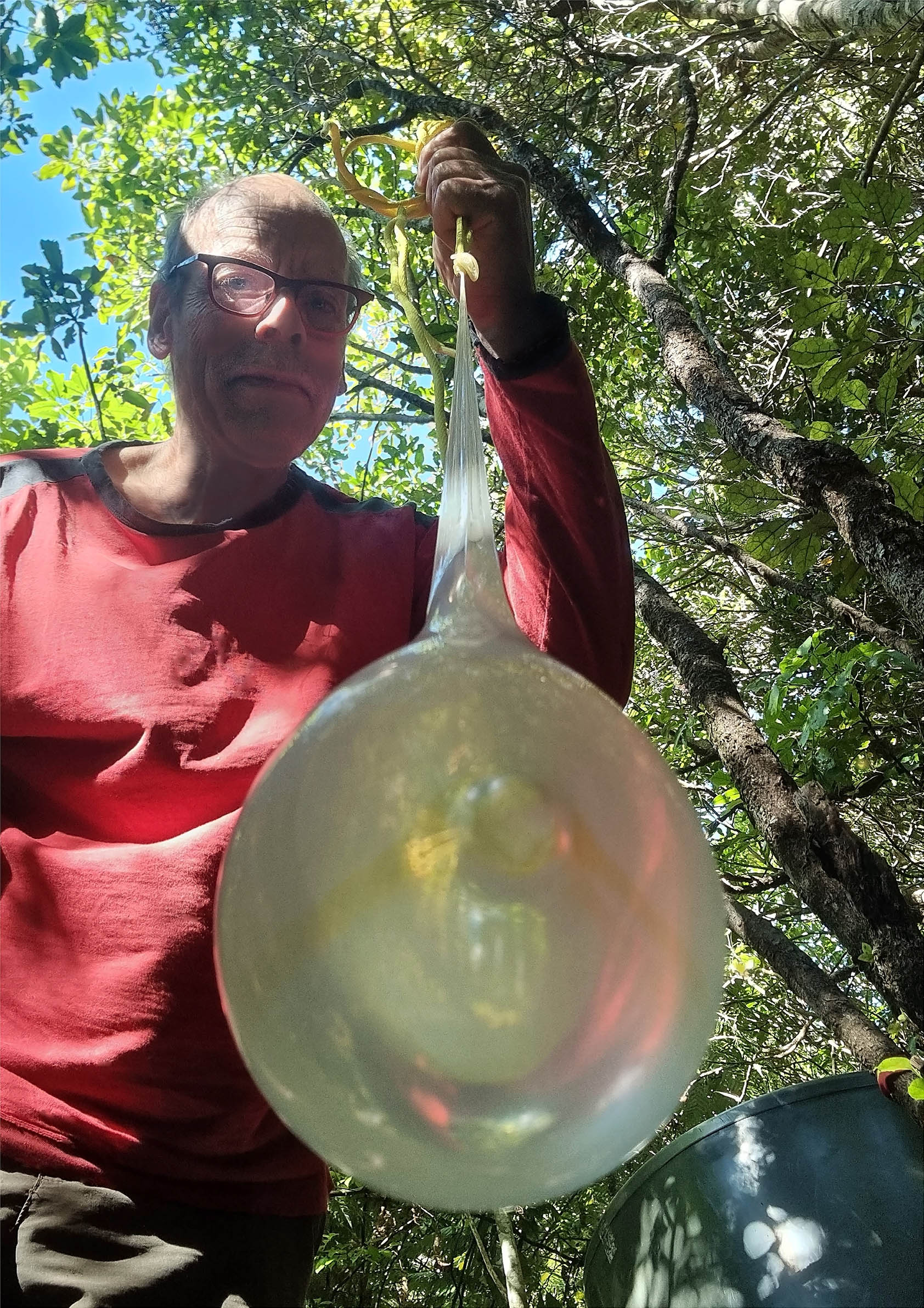
WATER: the most precious creation for life.
Why do we humans like shiny objects? It could be a result of millions of years of gazing at the stars. It might also be from the sunlight flickering through dense forests revealing to our primal forebears where a precious water source can be.
UNCONTAINED was exhibited at NJW 2022
Water: the most precious creation for life.
Why do we humans like shiny objects? It could be a result of millions of years of gazing at the mysterious stars. It might also be from the flickering of light through dense forests revealing our primal forebears where a precious water source can be.
ARTIST STATEMENT:
My practice has always revolved around the shifting identities of value — how it is formed, inherited, distorted, and imagined. Jewellery became my medium not for its preciousness, but for its contradictions: an underexplored terrain when I first stepped into it in 1973, where refinement, conflict, sentiment, and illusion collided.
My earliest influences were not gemstones but objects charged with human meaning: a 1970s Ban the Bomb badge, souvenir trinkets, my grandmother’s costume jewellery, and the coins my mother cut during the war so the metal could be traded for food. These fragments taught me that value is rarely intrinsic; it is projected, performed, or urgently needed.
I work with discarded and low‑value materials, following a process that circles back on itself rather than moving in a straight line. I return, revisit, and re‑enter the work from different angles, allowing each pass to shift what I see. Meaning emerges through repetition, hesitation, and the willingness to let the piece lead. Technique becomes a form of surrender rather than mastery — a step away from control and toward the intelligence of the material.
Over time, my practice has become an exploration of the illusions that shape contemporary perception. Jewellery, with its long history of symbolism and sentiment, offers a perfect site to question how value is constructed, distorted, or quietly reimagined.
Some pieces take minutes, others years. Some sit comfortably within jewellery; others resist categorisation entirely. All belong to an ongoing inquiry shaped by four recurring topics: Origins, Perception, Environment, and Conflict.
My work remains open-ended — a continual negotiation with the forces and illusions that give rise to value, always looping back, always beginning again.
Further reading:
makers’ marks
Bio (2026):
Peter Deckers is a Dutch–New Zealand artist whose practice spans jewellery, fine art, education, and sector leadership. Trained in the Netherlands and New Zealand, he maintains an active studio practice and exhibits nationally and internationally. His work investigates how value is perceived and communicated through the objects we choose to wear, and has been widely discussed in publications across the field.
Alongside his studio work, Peter has been a driving force in contemporary jewellery in Aotearoa. He is the founder and artistic director of the HANDSHAKE project—an internationally recognised programme supporting emerging artists—and a key organiser behind initiatives such as the Aotearoa Jewellery Triennial, the Suter Jewellery Biennial, and Jewellery LAB (at the National, Christchurch). His projects consistently expand opportunities for New Zealand artists, strengthen networks, and foster critical dialogue.
Peter is deeply committed to arts education and art development, advocating for each student’s individual creative potential. His ability to turn ideas into meaningful learning experiences underpins his long-standing contribution to the sector.
Born in the Netherlands, Peter immigrated to New Zealand with his wife, Hilda Gascard, in 1985. He completed his Master of Fine Arts at Elam School of Fine Arts in 2003. His work is held in major public and private collections, including Te Papa Tongarewa Museum of New Zealand, The Dowse Art Museum Collection, and the Danner Stiftung Collection, Munich, Germany.
Across making, teaching, curating, and organising, Peter’s practice centres on how value lives and changes — how objects endure, gather meaning, and return to us differently as we change.