
Pattern, Rupture, and the Adventure of Making
I now build these disruptions into my practice. Not as mistakes, but as catalysts. Predictability suffocates curiosity, so I create situations that force me to respond — where the work surprises me, challenges me, demands invention. It’s like Indian classical music, where two musicians improvise within a shared structure: one ends a phrase on an unresolved note, and the other must answer it. A challenge disguised as a gift. That is how I work — by inviting the unexpected and navigating what it asks of me.
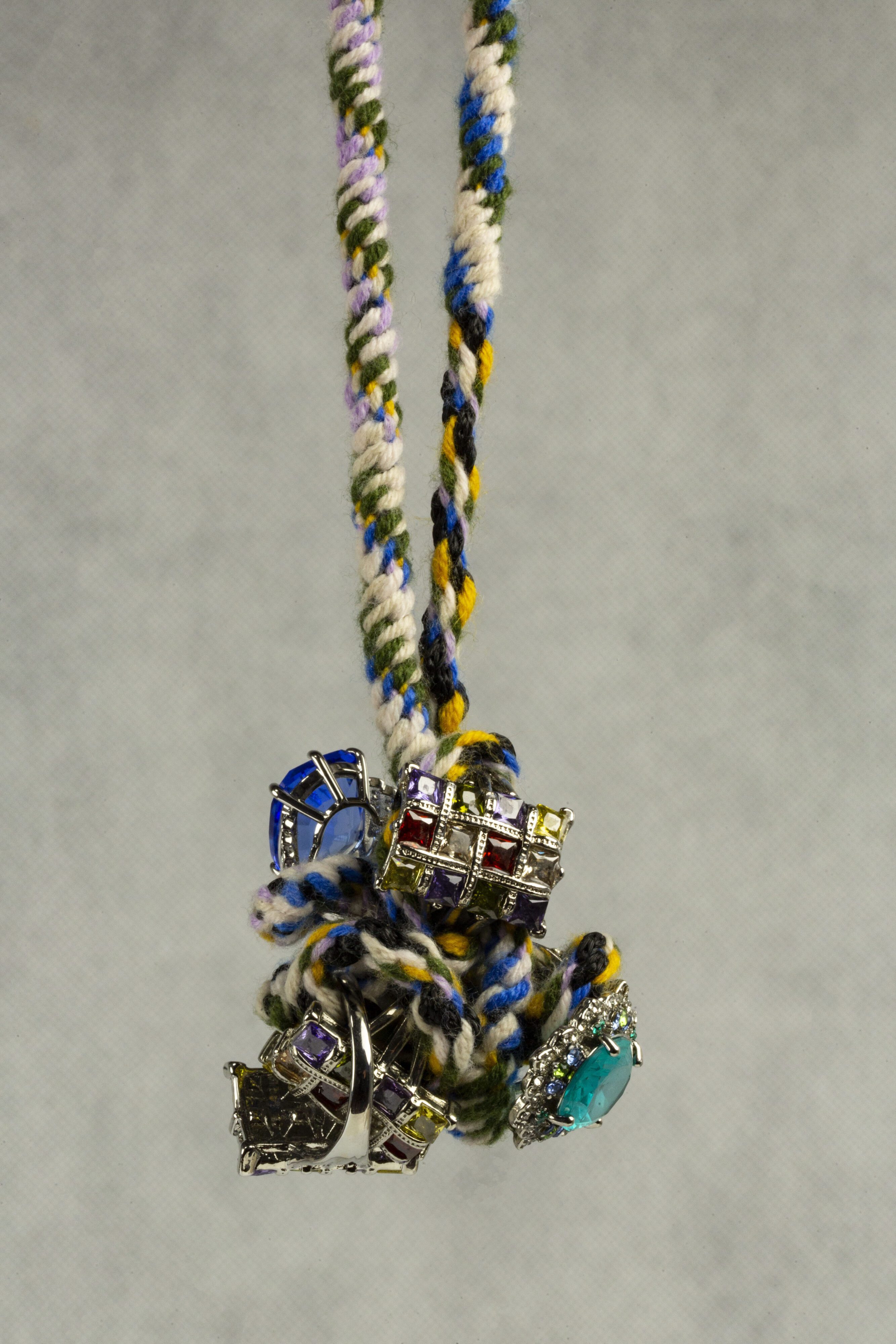
This logic extends to how the work is seen. My pieces stage a confrontation between two temporalities: the instant and the accumulative. A parachute cord, made by machine in seconds, could hold a series of stone‑encrusted rings perfectly well. But a Kumihimo cord, built thread by thread over hours or days, carries a different temporality. It interferes with the rings, binds them through colour, tension, and asymmetry, and becomes part of their meaning rather than merely their support. The time it takes is not a virtue in itself; if I could make it in seconds, I would. But the material won’t allow it. The slowness is not an aesthetic choice — it is the reality of a process that resists compression.
A machine‑made cord is absorbed by the eye in a split second. It is familiar, predictable, and asks little. My Kumihimo cords resist instant comprehension. They ask for attention — and they hold it, sometimes through curiosity, sometimes through discomfort. That act of holding is its own kind of time.
Craftsmanship was historically measured through its invested time — the hours of labour and the attention they demanded in return: not only the time required to make something, but the belief that slowness itself produces value. But our experience of time has changed. Attention, not material, has become a scarce resource. Value now emerges in the encounter — in the moment someone slows down enough to see. A hand‑braided cord may hold days of labour, but its worth is activated only when it is met with attention. In a distracted world, both a parachute cord and a Kumihimo braid can be skimmed in the same fraction of a second — yet only one rewards a second look. That choice becomes the new site of value.

Value, Continuum, and the Shape of Time
Kumihimo taught me something fundamental: when the materials stay constant, the sequence becomes decisive. The same threads, colours, fibres, density — nothing changes in the ingredients. Yet shift the order of movements, hesitate for a moment, cross a strand slightly off‑centre, introduce a deliberate interruption, and the pattern changes. The structure holds, but the outcome becomes something else. Life feels similar: its force is steady, but its character emerges from how we sequence it. The adventure lies not in new materials but in the willingness to disturb the pattern.
Physics echoes this intuition. Yoichiro Nambu’s work on symmetry breaking reveals how a system can be perfectly balanced and perfectly empty until that balance collapses. A ball poised on the tip of a cone has infinite identical possibilities; the moment it moves, symmetry disappears, and a specific reality appears. The laws remain unchanged — only the state shifts. From that tiny deviation, new properties emerge. My own process works similarly. The ingredients stay the same, but the smallest disruption — a pause, a misalignment, a deliberate break — is what makes the work come alive, the moment it begins to speak back.

Loop Thinking and the One‑Electron Universe
Running beneath all of this is loop thinking. The physicist John Wheeler’s speculation — that every electron is the same electron looping through time — offers a way to understand why ideas, materials, and moves return across my practice. What looks like multiplicity may simply be the same substance encountered at different moments. Difference becomes a matter of timing, not essence. Kumihimo revealed this long before I had language for it. The braid rests on a sequence so steady it borders on monotony, yet it changes the instant that sequence is disturbed. One underlying structure, endlessly revisiting itself, appears different only because I meet it from different points in time.
The loop, for me, is not repetition but return. Ideas reappear in new forms. Materials carry traces of their previous states. A gesture feels familiar one day and unfamiliar the next because I am not the same person encountering it. The loop is not a circle but a spiral — each pass slightly altered, each return carrying the memory of the last. Past and future fold into the present through the loops we inhabit. A technique observed in 2015 resurfaces in 2025 with new meaning. Custom jewellery rings with encrusted synthetic stones made in minutes meet a braid made over hours, and the encounter becomes a loop of temporalities. The artificial and the natural, the handmade and the mass‑produced — all become variations within one continuous unfolding.
This way of thinking shapes how I understand my own life. I’m not drawn to perfecting a pattern; I’m drawn to where it bends. The rupture — the moment the loop misbehaves — is where possibility enters. That’s adventure. Kumihimo taught me that the loop is not a mechanism of control but a generator of difference. Structure doesn’t limit freedom; it enables it.
In this sense, Artificial Universe is not just a title but a worldview. Everything we encounter — materials, ideas, selves — belongs to a looping continuum, returning in new forms, asking to be seen again. The loop becomes a way of navigating the world: not by chasing novelty, but by recognising the depth within repetition, the adventure within structure, the possibility within return.
Peter Deckers, Feb 2026
Value, Continuum, and the Shape of Time
Kumihimo taught me something fundamental: when the materials stay constant, the sequence becomes decisive. The same threads, colours, fibres, density — nothing changes in the ingredients. Yet shift the order of movements, hesitate for a moment, cross a strand slightly off‑centre, introduce a deliberate interruption, and the pattern changes. The structure holds, but the outcome becomes something else. Life feels similar: its force is steady, but its character emerges from how we sequence it. The adventure lies not in new materials but in the willingness to disturb the pattern.
Physics echoes this intuition. Yoichiro Nambu’s work on symmetry breaking shows how a system can be perfectly balanced and perfectly empty until that balance collapses. A ball poised on the tip of a cone has infinite identical possibilities; the moment it moves, symmetry disappears and a specific reality appears. The laws remain unchanged — only the state shifts. From that tiny deviation, new properties emerge. My own process works similarly. The ingredients stay the same, but the smallest disruption — a pause, a misalignment, a deliberate break — is what makes the work come alive, the moment it begins to speak back.
Pattern, Rupture, and the Adventure of Making
I now build these disruptions into my practice. Not as mistakes, but as catalysts. Predictability suffocates curiosity, so I create situations that force me to respond — where the work surprises me, challenges me, demands invention. It’s like Indian classical music, where two musicians improvise within a shared structure: one ends a phrase on an unresolved note, and the other must answer it. A challenge disguised as a gift. That is how I work — by inviting the unexpected and navigating what it asks of me.
This logic extends to how the work is seen. My pieces stage a confrontation between two temporalities: the instant and the accumulative. A parachute cord, made by machine in seconds, could hold a series of stone-encrusted rings perfectly well. But a Kumihimo cord, built thread by thread over hours or days, carries a different temporality. It interferes with the rings, binds them through colour, tension, and asymmetry, and becomes part of their meaning rather than merely their support. The time it takes is not a virtue in itself; if I could make it in seconds, I would. But the material won’t allow it. The slowness is not an aesthetic choice — it is the reality of a process that resists compression.
Loop Thinking and the One‑Electron Universe
Running beneath all of this is loop thinking. The physicist John Wheeler’s speculation — that every electron is the same electron looping through time — offers a way to understand why ideas, materials, and moves return across my practice. What looks like multiplicity may simply be the same substance encountered at different moments. Difference becomes a matter of timing, not essence. Kumihimo revealed this long before I had language for it. The braid rests on a sequence so steady it borders on monotony, yet it changes the instant that sequence is disturbed. One underlying structure, endlessly revisiting itself, appears different only because I meet it from different points in time.
The loop, for me, is not repetition but return. Ideas reappear in new forms. Materials carry traces of their previous states. A gesture feels familiar one day and unfamiliar the next because I am not the same person encountering it. The loop is not a circle but a spiral — each pass slightly altered, each return carrying the memory of the last. Past and future fold into the present through the loops we inhabit. A technique observed in 2015 resurfaces in 2025 with new meaning. Custom jewellery rings with encrusted synthetic stones made in minutes meet a braid made over hours, and the encounter becomes a loop of temporalities. The artificial and the natural, the handmade and the mass‑produced — all become variations within one continuous unfolding.
This way of thinking shapes how I understand my own life. I’m not drawn to perfecting a pattern; I’m drawn to where it bends. The rupture — the moment the loop misbehaves — is where possibility enters. That’s adventure. Kumihimo taught me that the loop is not a mechanism of control but a generator of difference. Structure doesn’t limit freedom; it enables it.
In this sense, Artificial Universe is not just a title but a worldview. Everything we encounter — materials, ideas, selves — belongs to a looping continuum, returning in new forms, asking to be seen again. The loop becomes a way of navigating the world: not by chasing novelty, but by recognising the depth within repetition, the adventure within structure, the possibility within return.
Peter Deckers, Feb 2026