


Concealments — Taste, Attention, and the Making of Value
How do we tell a diamond from a fake. We don’t. Not really. We respond from habit, memory, desire, suspicion, ethics — all the things we carry without noticing. A trader sees one thing, a cynic another, someone grieving sees something else again. A stone becomes precious or worthless depending on who we are when we look at it. The eye gives away more about us than about the material.
It is striking how quickly materials are read, how value judgements form before thought has time to catch up — how a reflection becomes more compelling when it slips through mesh, bars, or shadow. The smallest obstruction can shift perception, asking the eye to lean in, to search, to wonder what is that. The world doesn’t disappear; it withdraws just enough to sharpen attention. What is covered becomes an invitation to look again.
When a reflection is interrupted, perception changes course. The eye recalibrates. The mind fills in what is missing. Looking becomes active rather than passive, generative rather than given. Meaning arises not from clarity but from the tension between what is seen and what is suggested — a small perceptual loop that returns the world in altered form.
This is also where the politics of taste comes into view. Costume jewellery — the material that shaped my early fascinations — has long been dismissed as “bad taste.” It is rejected for being fake, mass‑produced, decorative, aligned with cheap fashion. Within contemporary jewellery discourse, it is treated as unserious: too shiny, too accessible, too eager to please. But these judgements reveal more about cultural conditioning than about the objects themselves. They are loops of taste — inherited, repeated, rarely examined.
I am not immune to automatic value judgements; none of us are. They live in the culture we breathe, shaping our instincts long before thought arrives. Part of my practice is learning to notice those reflexes and unravel them — to look past what I’ve absorbed and return to what an object actually is. Not what a movement claims it should be, not what fashion declares, not what rhetoric repeats, but what stands in front of me.
That way of looking began early. As a child, I was captivated by my grandmother’s costume jewellery collection — the variety, the colour, the sense of importance it carried. But when I looked closer, the pieces revealed themselves as a kind of circus stunt: mirrors behind coloured glass, flashes of foil, bright stones held in rudimentary settings, all performing sophistication through design. Simple materials creating extraordinary optical effects. Being tricked didn’t diminish them; it made them more compelling. That slip in perception — that moment when my judgement failed — became central to my thinking once I began making art.
When I first arrived in Aotearoa, I was struck by how naturally Māori artists drew from their origins — how whakapapa, land, and lineage were not themes but living structures inside their work. When I turned inward to ask what my own background offered, I found something far less straightforward. In a Western upbringing, looking back is not encouraged; origins are often obscured, fragmented, or treated as irrelevant. What surfaced for me was my grandmother’s costume jewellery — bright, playful, and deceptively simple — and a larger history that felt partly present and partly unknowable. That tension became a starting point. I reworked one of her brooches not to honour heritage in a traditional sense, but to understand how perception, memory, and value could be activated through the smallest shift in visibility.
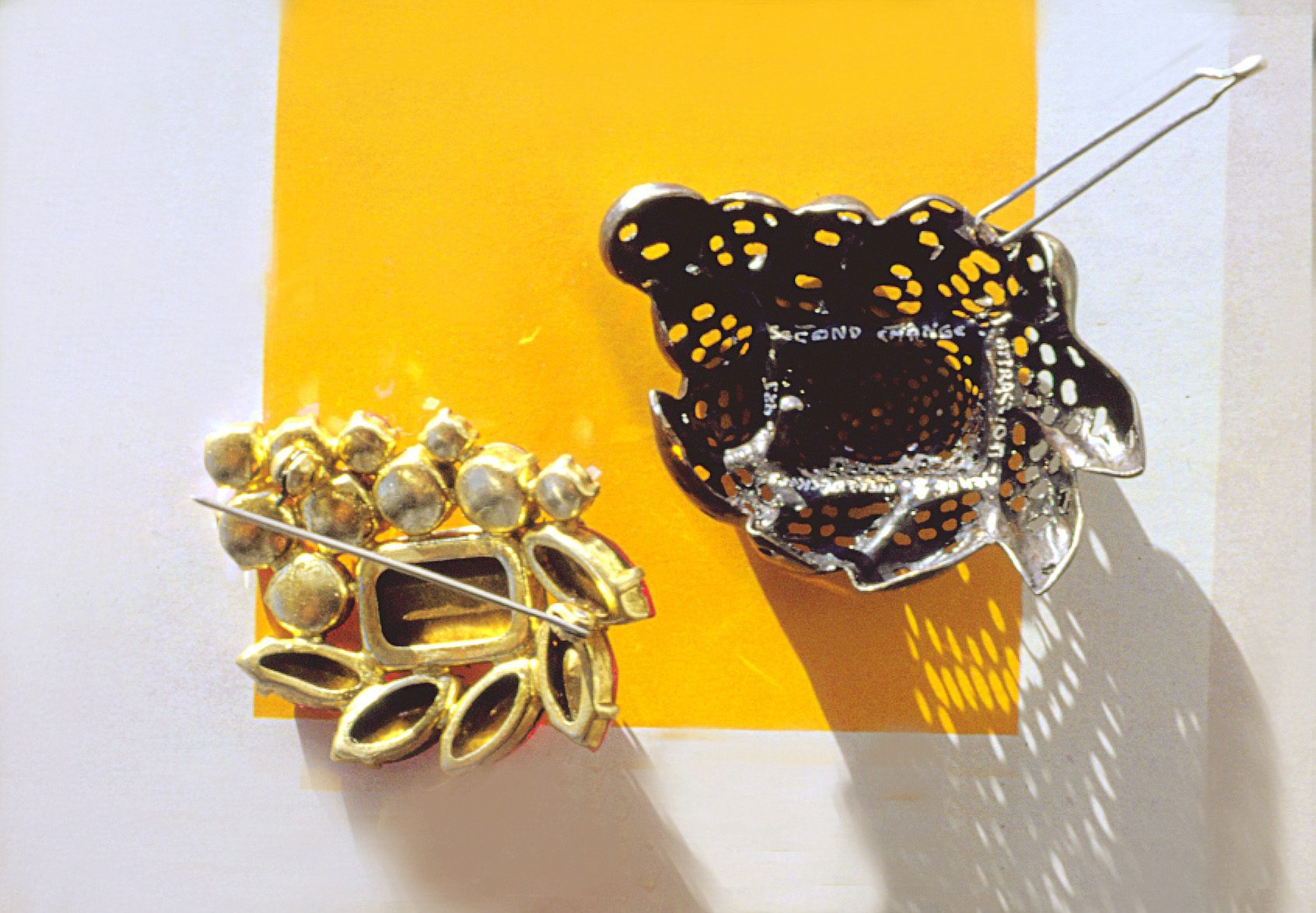
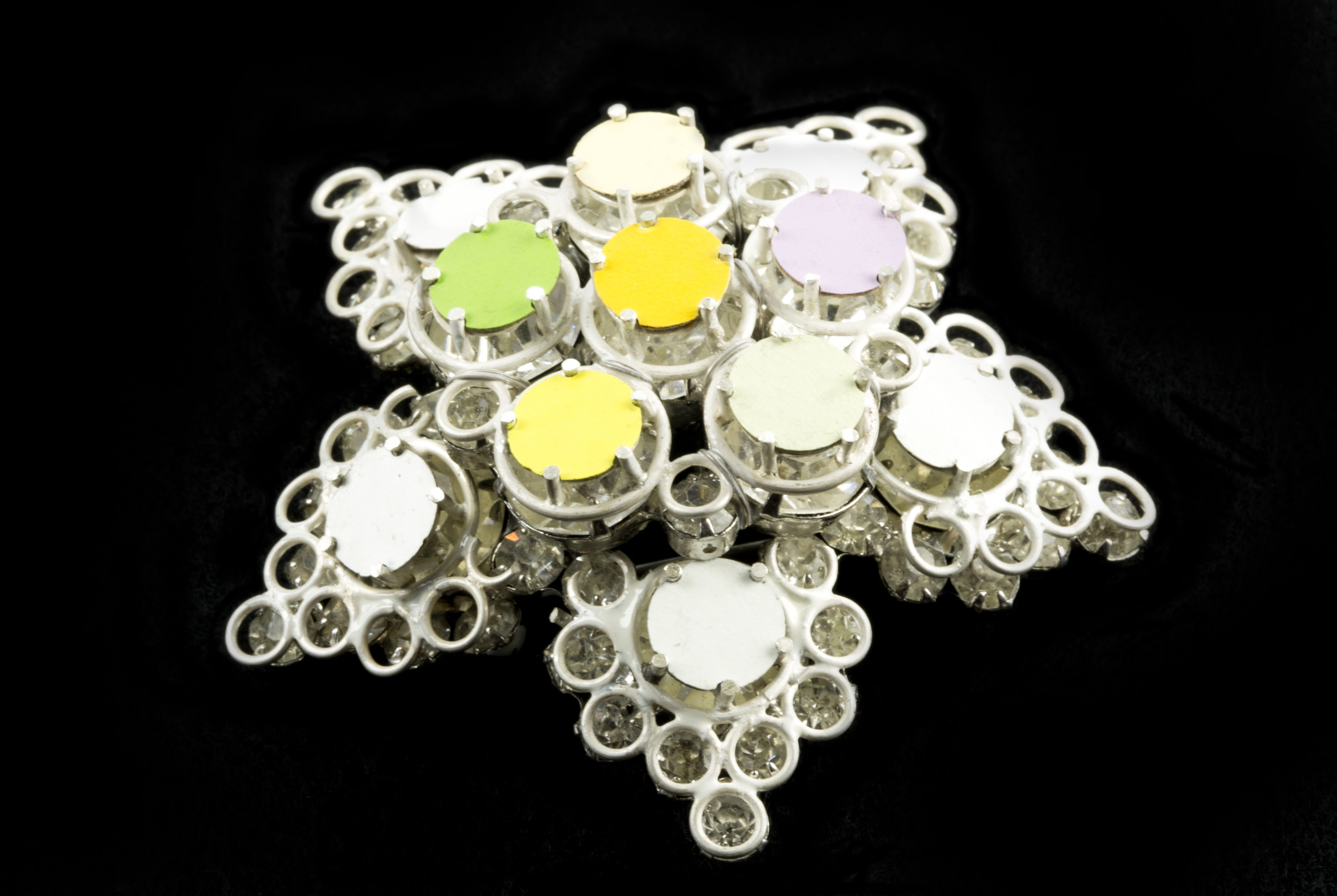
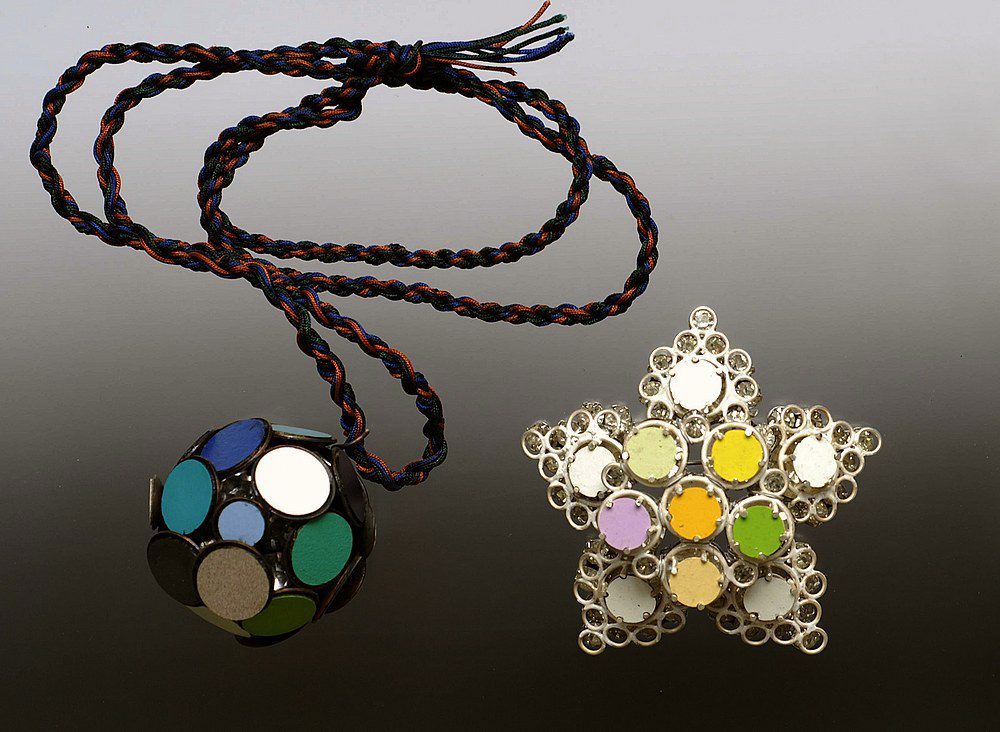
Since 1990, I have worked with old costume jewellery, covering it with mesh‑like structures made from silver plate and wire. These coverings are shaped to the varying heights of the stones beneath, creating forms that echo modernist concerns with structure and function, but in a way that feels more post‑modern — layered, playful, self‑aware. Through these coverings, the jewellery becomes partially hidden, partially revealed. Flashpoints of colour and reflection slip through the mesh, creating a perceptual tension: the eye knows something is there, but must work to see it.
The jewellery inside remains unchanged, yet the covering transforms the encounter. One and one becomes more than two. The illusion is not deception; it is a perceptual loop. The viewer is not tricked — they are activated. They navigate between surface and depth, between what is offered and what is withheld.
People who pride themselves on “good taste” often dislike being unsettled by fakes. But the discomfort reveals a deeper truth: value is not inherent. It is constructed through loops of perception, belief, and cultural expectation. By reframing costume jewellery — not by hiding it, but by shifting the conditions of its visibility — I test those loops. I ask what happens when the “fake” becomes compelling, when the overlooked becomes luminous, when the rejected becomes worthy of attention.
Interruption slows the encounter. It sharpens attention. It reveals how meaning is shaped not by purity or preciousness, but by the interplay of light, memory, material, and context. The unseen shapes the seen. The withheld shapes the revealed. The object becomes a site of re‑seeing — a reminder that perception is always provisional, always looping, always capable of returning something unexpected.
Costume jewellery may be dismissed as unreal, but its effects are real. Its impact is real. Its ability to hold memory, desire, and presence is real. My work simply gives it a second chance — not to imitate value, but to reveal the perceptual loops that create value in the first place.
Concealments — Taste, Attention, and the Making of Value
How do we tell a diamond from a fake. We don’t. Not really. We respond from habit, memory, desire, suspicion, ethics — all the things we carry without noticing. A trader sees one thing, a cynic another, someone grieving sees something else again. A stone becomes precious or worthless depending on who we are when we look at it. The eye gives away more about us than about the material.
It is striking how quickly materials are read, how value judgements form before thought has time to catch up — how a reflection becomes more compelling when it slips through mesh, bars, or shadow. The smallest obstruction can shift perception, asking the eye to lean in, to search, to wonder what is that. The world doesn’t disappear; it withdraws just enough to sharpen attention. What is covered becomes an invitation to look again.
When a reflection is interrupted, perception changes course. The eye recalibrates. The mind fills in what is missing. Looking becomes active rather than passive, generative rather than given. Meaning arises not from clarity but from the tension between what is seen and what is suggested — a small perceptual loop that returns the world in altered form.
This is also where the politics of taste comes into view. Costume jewellery — the material that shaped my early fascinations — has long been dismissed as “bad taste.” It is rejected for being fake, mass‑produced, decorative, aligned with cheap fashion. Within contemporary jewellery discourse, it is treated as unserious: too shiny, too accessible, too eager to please. But these judgements reveal more about cultural conditioning than about the objects themselves. They are loops of taste — inherited, repeated, rarely examined.
I am not immune to automatic value judgements; none of us are. They live in the culture we breathe, shaping our instincts long before thought arrives. Part of my practice is learning to notice those reflexes and unravel them — to look past what I’ve absorbed and return to what an object actually is. Not what a movement claims it should be, not what fashion declares, not what rhetoric repeats, but what stands in front of me.
That way of looking began early. As a child, I was captivated by my grandmother’s costume jewellery collection — the variety, the colour, the sense of importance it carried. But when I looked closer, the pieces revealed themselves as a kind of circus stunt: mirrors behind coloured glass, flashes of foil, bright stones held in rudimentary settings, all performing sophistication through design. Simple materials creating extraordinary optical effects. Being tricked didn’t diminish them; it made them more compelling. That slip in perception — that moment when my judgement failed — became central to my thinking once I began making art.
When I first arrived in Aotearoa, I was struck by how naturally Māori artists drew from their origins — how whakapapa, land, and lineage were not themes but living structures inside their work. When I turned inward to ask what my own background offered, I found something far less straightforward. In a Western upbringing, looking back is not encouraged; origins are often obscured, fragmented, or treated as irrelevant. What surfaced for me was my grandmother’s costume jewellery — bright, playful, and deceptively simple — and a larger history that felt partly present and partly unknowable. That tension became a starting point. I reworked one of her brooches not to honour heritage in a traditional sense, but to understand how perception, memory, and value could be activated through the smallest shift in visibility.
Since 1990, I have worked with old costume jewellery, covering it with mesh‑like structures made from silver plate and wire. These coverings are shaped to the varying heights of the stones beneath, creating forms that echo modernist concerns with structure and function, but in a way that feels more post‑modern — layered, playful, self‑aware. Through these coverings, the jewellery becomes partially hidden, partially revealed. Flashpoints of colour and reflection slip through the mesh, creating a perceptual tension: the eye knows something is there, but must work to see it.
The jewellery inside remains unchanged, yet the covering transforms the encounter. One and one becomes more than two. The illusion is not deception; it is a perceptual loop. The viewer is not tricked — they are activated. They navigate between surface and depth, between what is offered and what is withheld.
People who pride themselves on “good taste” often dislike being unsettled by fakes. But the discomfort reveals a deeper truth: value is not inherent. It is constructed through loops of perception, belief, and cultural expectation. By reframing costume jewellery — not by hiding it, but by shifting the conditions of its visibility — I test those loops. I ask what happens when the “fake” becomes compelling, when the overlooked becomes luminous, when the rejected becomes worthy of attention.
Interruption slows the encounter. It sharpens attention. It reveals how meaning is shaped not by purity or preciousness, but by the interplay of light, memory, material, and context. The unseen shapes the seen. The withheld shapes the revealed. The object becomes a site of re‑seeing — a reminder that perception is always provisional, always looping, always capable of returning something unexpected.
Costume jewellery may be dismissed as unreal, but its effects are real. Its impact is real. Its ability to hold memory, desire, and presence is real. My work simply gives it a second chance — not to imitate value, but to reveal the perceptual loops that create value in the first place.